← All visual series

Bent Lines

The problem usually fits in one scene.

Bent Lines compress a familiar system problem into a single editorial sketch. The collection is continuous: figure numbers identify the work, while the index lets you move directly to any drawing.

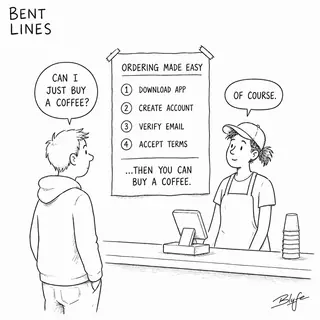
Black-and-white Bent Lines sketch of a customer at a coffee counter where a sign requires downloading an app, creating an account, verifying email, and accepting terms before buying coffee.

Bent Lines BL0001

Ordering Made Easy

A simple coffee order turns into an app download, an account, an email check, and a set of terms.

Bent Lines

Ordering Made Easy

One coffee now comes with four setup jobs.

Black-and-white Bent Lines sketch of a customer at a coffee counter where a sign requires downloading an app, creating an account, verifying email, and accepting terms before buying coffee.
Read the visual transcript and evidence receipt

Figure transcript

Main point

The drawing treats digital onboarding as part of the purchase price. The customer wants one coffee; the process assigns four administrative jobs before the transaction can begin.

Reading order
  1. A customer asks the worker, “Can I just buy a coffee?”
  2. A large “Ordering Made Easy” sign lists four required setup steps.
  3. The worker answers, “Of course,” while the sign concludes that coffee comes after the setup.
Material labels and values

The sign reads “Ordering Made Easy” and lists: “1. Download app,” “2. Create account,” “3. Verify email,” and “4. Accept terms,” followed by “…then you can buy a coffee.” The customer asks, “Can I just buy a coffee?” The worker replies, “Of course.”

Scope and caveats

This is an editorial scene, not a measurement of every coffee shop or app-based purchase. It does not estimate how often onboarding is required or how long the four steps take.

Editorial layer

Claim layer: Argued. The argued point is that a low-value transaction can transfer account setup and compliance work to the customer. The joke depends on the gap between the word “easy” and the work shown underneath it.

Update and correction status

Status: current. The website uses the publisher-approved BL0001-Ordering-Made-Easy.png master without changing its pixels, crop, lettering, linework, or Blyfe signature. The imported file was checked on August 28, 2026. Its SHA-256 is e056b494041d934755e599c889e52bff8d646997b31680ee00d904daa22dd91b. Any visual correction requires a new publisher-approved master and a recorded checksum change.

Evidence receipt

  • External data: None. This Bent Line is an editorial observation and does not present empirical findings.
  • Approved master: BL0001-Ordering-Made-Easy.png, 1254 × 1254 pixels.
  • Related bent.WTF records: administrative burden, sludge, access distortion.
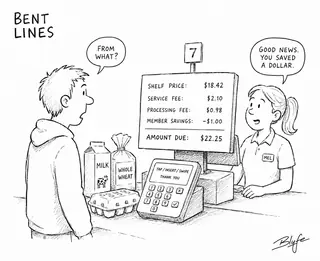
Black-and-white Bent Lines grocery checkout sketch where a cashier celebrates one dollar in member savings while the screen lists shelf price, service fee, processing fee, and a higher amount due.

Bent Lines BL0002

Saved a Dollar

A checkout celebrates one dollar of member savings while several added fees lift the amount due.

Bent Lines

Saved a Dollar

A dollar gets the applause; the amount due stays on the screen.

Black-and-white Bent Lines grocery checkout sketch where a cashier celebrates one dollar in member savings while the screen lists shelf price, service fee, processing fee, and a higher amount due.
Read the visual transcript and evidence receipt

Figure transcript

Main point

The checkout praises a visible discount while the screen carries added charges. The customer’s question—“From what?”—turns the celebration back toward the total.

Reading order
  1. The customer stands at a grocery checkout with milk, bread, and eggs.
  2. The screen lists the shelf price, two added fees, member savings, and the amount due.
  3. The cashier announces the one-dollar saving; the customer asks what it was saved from.
Material labels and values

The screen reads: “Shelf price: $18.42,” “Service fee: $2.10,” “Processing fee: $0.98,” “Member savings: −$1.00,” and “Amount due: $22.25.” The cashier says, “Good news. You saved a dollar.” The customer asks, “From what?”

Scope and caveats

The figures are illustrative rather than a documented transaction. The displayed line items produce $20.50, which is $1.75 below the shown $22.25 amount due. The website reproduces that discrepancy openly because the approved master is preserved unchanged; it must not be used as a worked calculation.

Editorial layer

Claim layer: Argued. The argued point is not that discounts are false. It is that a highlighted saving can command attention while the household still pays more after fees.

Update and correction status

Status: current. The website uses the publisher-approved BL0002-Saved-A-Dollar.png master without changing its pixels, crop, lettering, linework, or Blyfe signature. The imported file was checked on August 28, 2026. Its SHA-256 is 28b89d3952e36da4780c04f153fbdc925fd787336b495c0f1d3d670c72ae1113. Any visual correction requires a new publisher-approved master and a recorded checksum change.

Evidence receipt

  • External data: None. This Bent Line is an editorial observation and does not present empirical findings.
  • Approved master: BL0002-Saved-A-Dollar.png, 1390 × 1132 pixels.
  • Related bent.WTF records: hidden cost, junk fees total price, the price tag mask.
Black-and-white Bent Lines sketch showing a person, a tiny ladder, and a checklist below a high cliff topped by a starter home advertised from $450,000.

Bent Lines BL0003

Starter Home

A familiar checklist for getting ahead ends at a tiny ladder beneath a starter home on a high cliff.

Bent Lines

Starter Home

The checklist can be honest while the ladder is too short.

Black-and-white Bent Lines sketch showing a person, a tiny ladder, and a checklist below a high cliff topped by a starter home advertised from $450,000.
Read the visual transcript and evidence receipt

Figure transcript

Main point

The scene separates personal discipline from structural reach. The person has been given a familiar checklist, but the ladder supplied by that advice does not reach the advertised starter home.

Reading order
  1. A person stands at the base of a high cliff beside a very short ladder.
  2. A checklist says to earn good grades, save money, avoid debt, work hard, and play by the rules.
  3. At the top, a house sits beside a sign reading “Starter home from $450,000.”
Material labels and values

The checklist reads: “Good grades,” “Save money,” “No debt,” “Work hard,” and “Play by the rules.” The sign above reads “Starter home from $450,000.”

Scope and caveats

The $450,000 sign is an illustrative price inside an editorial cartoon, not a national median, local listing, affordability threshold, or forecast. The drawing does not claim that effort is irrelevant or that every market presents the same gap.

Editorial layer

Claim layer: Argued. The argued point is that conventional advice can remain sensible even when the distance between that advice and a major milestone has widened.

Update and correction status

Status: current. The website uses the publisher-approved BL0003-Starter-Home.png master without changing its pixels, crop, lettering, linework, or Blyfe signature. The imported file was checked on August 28, 2026. Its SHA-256 is 8e176120732f3fdde8df7e03a69f5ab51f302b13738b4d743a862079204ee045. Any visual correction requires a new publisher-approved master and a recorded checksum change.

Evidence receipt

  • External data: None. This Bent Line is an editorial observation and does not present empirical findings.
  • Approved master: BL0003-Starter-Home.png, 1254 × 1254 pixels.
  • Related bent.WTF records: hidden cost, household margin, access distortion.
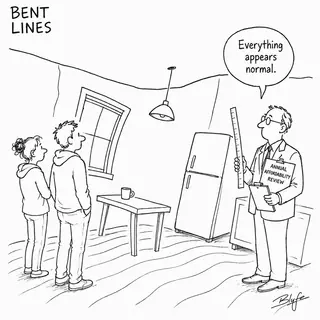
Black-and-white Bent Lines sketch of a couple in a visibly tilted kitchen while an official holding an Annual Affordability Review and a level says everything appears normal.

Bent Lines BL0004

Everything Appears Normal

An official checks a level instrument inside a visibly tilted room and reports that everything appears normal.

Bent Lines

Everything Appears Normal

A level tool can make a tilted room look official.

Black-and-white Bent Lines sketch of a couple in a visibly tilted kitchen while an official holding an Annual Affordability Review and a level says everything appears normal.
Read the visual transcript and evidence receipt

Figure transcript

Main point

The room is visibly out of alignment, but the official’s instrument reports no problem. The drawing asks what a valid-looking measurement can miss when its frame is narrower than the life being measured.

Reading order
  1. A couple stands in a kitchen where the window, refrigerator, lamp, table, and floor all lean.
  2. An official holds a level beside a folder labeled “Annual Affordability Review.”
  3. The official looks at the instrument and says, “Everything appears normal.”
Material labels and values

The folder reads “Annual Affordability Review.” The speech bubble says, “Everything appears normal.” No numeric result appears.

Scope and caveats

This is a conceptual cartoon, not a claim about a named affordability index or agency. The level represents a narrow measurement frame; it does not reproduce an actual methodology.

Editorial layer

Claim layer: Argued. The argued point is that a measure can be internally consistent and still fail to describe the surrounding condition people are living through.

Update and correction status

Status: current. The website uses the publisher-approved BL0004-Everything-Appears-Normal.png master without changing its pixels, crop, lettering, linework, or Blyfe signature. The imported file was checked on August 28, 2026. Its SHA-256 is 0832f3f4b2971e72c3c8bfec35023281b0bff234a748c48d7c3f7d98bf44b70b. Any visual correction requires a new publisher-approved master and a recorded checksum change.

Evidence receipt

  • External data: None. This Bent Line is an editorial observation and does not present empirical findings.
  • Approved master: BL0004-Everything-Appears-Normal.png, 1254 × 1254 pixels.
  • Related bent.WTF records: measurement failure, institutional fog, access distortion.
Black-and-white Bent Lines hospital sketch where a patient in bed faces a long itemized bill totaling $12,187 while a Patient Experience Director calls the total routine.

Bent Lines BL0005

Pretty Typical

A hospital patient receives a $12,187 one-night bill and is told that the total is pretty typical.

Bent Lines

Pretty Typical

Normal is a statistical word until the bill arrives.

Black-and-white Bent Lines hospital sketch where a patient in bed faces a long itemized bill totaling $12,187 while a Patient Experience Director calls the total routine.
Read the visual transcript and evidence receipt

Figure transcript

Main point

The phrase “pretty typical” is placed beside a bill large enough to shock the patient. The scene focuses on the distance between institutional familiarity and household consequence.

Reading order
  1. A patient sits upright in a hospital bed beside an IV stand.
  2. A Patient Experience Director holds an itemized bill that is nearly floor length.
  3. The director calls the bill typical while the patient stares at the total; the speech bubble visibly misspells the word as “tupical.”
Material labels and values

The bill reads: “One-night stay,” “Room fee $4,200,” “Medication fee $1,437,” “Facility fee $3,050,” “Recovery fee $3,500,” and “Total $12,187.” The employee badge reads “Patient Experience Director.” The speech bubble visibly says, “That’s pretty tupical.” This transcript records the lettering as drawn rather than silently repairing it.

Scope and caveats

The charges are illustrative and are not presented as a national average, a quotation from a hospital, or a statement about insured net cost. They add to the shown total, but they do not represent a sourced medical bill.

Editorial layer

Claim layer: Argued. The argued point is that a cost can become routine inside a system without becoming manageable for the person receiving it.

Update and correction status

Status: current. The website uses the publisher-approved BL0005-Pretty-Typical.png master without changing its pixels, crop, lettering, linework, or Blyfe signature. The imported file was checked on August 28, 2026. Its SHA-256 is 541b1a4e1ad2f7f247429c72118121ba09fc06103ff8361da96aa57f756f8214. Any visual correction requires a new publisher-approved master and a recorded checksum change.

Evidence receipt

  • External data: None. This Bent Line is an editorial observation and does not present empirical findings.
  • Approved master: BL0005-Pretty-Typical.png, 1254 × 1254 pixels.
  • Related bent.WTF records: hidden cost, the price tag mask, household margin.
Black-and-white Bent Lines sketch of a person locked outside a home as the smart lock says unable to verify owner and the phone says no service, while another person walks away holding physical keys.

Bent Lines BL0006

Unable to Verify Owner

A homeowner stands at a smart lock that cannot verify the owner while the phone reads No Service.

Bent Lines

Unable to Verify Owner

The deed does not open a lock that needs a connection.

Black-and-white Bent Lines sketch of a person locked outside a home as the smart lock says unable to verify owner and the phone says no service, while another person walks away holding physical keys.
Read the visual transcript and evidence receipt

Figure transcript

Main point

Ownership and access have been separated. The person is at the front door, but the device requires a working verification chain before it will recognize the owner.

Reading order
  1. A person stands on a “Welcome Home” mat facing a smart front-door lock.
  2. The lock displays “Unable to verify owner,” and the phone displays “No Service.”
  3. In the background, another person walks away carrying ordinary keys.
Material labels and values

The door display reads “Unable to verify owner” with an X. The phone reads “No Service” with an X. The doormat reads “Welcome Home.”

Scope and caveats

The scene is a hypothetical illustration, not a reliability finding about a named smart-lock product. The person with keys provides contrast; the drawing does not assign wrongdoing or claim that physical keys are always safer.

Editorial layer

Claim layer: Argued. The argued point is that a product sold as ownership can still make practical access depend on a vendor, device, account, network, or verification service.

Update and correction status

Status: current. The website uses the publisher-approved BL0006-Unable-To-Verify-Owner.png master without changing its pixels, crop, lettering, linework, or Blyfe signature. The imported file was checked on August 28, 2026. Its SHA-256 is c2aa3d0677f35a164abbecc8e1df7b4ddeba1629cffc7cef858a0070b15142bd. Any visual correction requires a new publisher-approved master and a recorded checksum change.

Evidence receipt

Black-and-white Bent Lines sketch of a farmer carrying grain at a market counter where a clerk lists request permission, submit forms, pay fee, and wait before selling.

Bent Lines BL0007

Market Procedure

A farmer arrives with grain and learns that selling first requires permission, forms, a fee, and a wait.

Bent Lines

Market Procedure

Before grain reaches the stall, the farmer has paperwork to finish.

Black-and-white Bent Lines sketch of a farmer carrying grain at a market counter where a clerk lists request permission, submit forms, pay fee, and wait before selling.
Read the visual transcript and evidence receipt

Figure transcript

Main point

The farmer has a product and a willing market in front of the stall, yet the first transaction is administrative. The four-step procedure becomes the gate through which exchange must pass.

Reading order
  1. A farmer carrying a sack marked “Grain” asks what is required to sell.
  2. A clerk behind a wooden market counter points to the procedure; stone arches stand behind the stall.
  3. The posted steps end with “Then you may sell.”
Material labels and values

The farmer asks, “What do I have to do to sell here?” The clerk replies, “First, you must follow the market procedure.” The sign lists: “1. Request permission,” “2. Submit forms,” “3. Pay fee,” “4. Wait,” followed by “Then you may sell.”

Scope and caveats

This is a generalized editorial scene, not a description of a particular permit, market, jurisdiction, or historical period. It does not weigh the public purposes that licensing and market rules may serve.

Editorial layer

Claim layer: Argued. The argued point is that process can become part of market access, transferring time and compliance work to the person trying to participate.

Update and correction status

Status: current. The website uses the publisher-approved BL0007-Market-Procedure.png master without changing its pixels, crop, lettering, linework, or Blyfe signature. The imported file was checked on August 28, 2026. Its SHA-256 is 70a70d522bf9f2125a11faddd2b3a5ed48aeabaecfc36b3dabd4a5466045b1ea. Any visual correction requires a new publisher-approved master and a recorded checksum change.

Evidence receipt

  • External data: None. This Bent Line is an editorial observation and does not present empirical findings.
  • Approved master: BL0007-Market-Procedure.png, 1449 × 1086 pixels.
  • Related bent.WTF records: sludge, administrative burden, access distortion.
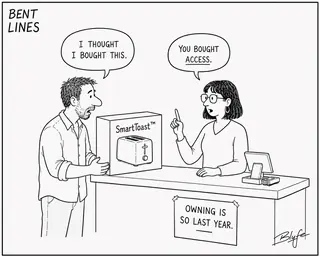
Black-and-white Bent Lines store-counter sketch where a customer holding a SmartToast box says it was purchased and the clerk replies that the purchase bought access; a sign says owning is so last year.

Bent Lines BL0008

You Bought Access

A customer holding a boxed smart toaster is told that the purchase bought access, not the appliance.

Bent Lines

You Bought Access

The customer carries home a toaster—and permission to use it.

Black-and-white Bent Lines store-counter sketch where a customer holding a SmartToast box says it was purchased and the clerk replies that the purchase bought access; a sign says owning is so last year.
Read the visual transcript and evidence receipt

Figure transcript

Main point

The physical product is in the customer’s hands, but the clerk describes the transaction as access. The scene compresses the shift from owning a durable object to depending on continuing permission.

Reading order
  1. A customer holds a boxed product labeled “SmartToast.”
  2. The customer says, “I thought I bought this.” The clerk raises a finger and replies, “You bought access.”
  3. A sign on the counter reads “Owning is so last year.”
Material labels and values

The box is labeled “SmartToast.” The dialogue reads: “I thought I bought this.” “You bought access.” The counter sign reads “Owning is so last year.”

Scope and caveats

SmartToast is fictional. The drawing does not describe a named appliance, licensing agreement, or legal conclusion about ownership. It is an editorial compression of access-dependent products.

Editorial layer

Claim layer: Argued. The argued point is that possession can look like ownership while continued use remains conditional on software, accounts, subscriptions, or vendor permission.

Update and correction status

Status: current. The website uses the publisher-approved BL0008-You-Bought-Access.png master without changing its pixels, crop, lettering, linework, or Blyfe signature. The imported file was checked on August 28, 2026. Its SHA-256 is 37c58066ab7323dca112a59df83fa960f4de46d21ad348287be5c1e70db06762. Any visual correction requires a new publisher-approved master and a recorded checksum change.

Evidence receipt

  • External data: None. This Bent Line is an editorial observation and does not present empirical findings.
  • Approved master: BL0008-You-Bought-Access.png, 1402 × 1122 pixels.
  • Related bent.WTF records: access distortion, hidden cost, institutional fog.
Black-and-white Bent Lines landscape showing a crowd on a recommended fast, easy, approved route and a separate steep path marked think for yourself, while a traveler asks where it goes.

Bent Lines BL0009

Think for Yourself

A crowded recommended route is fast, easy, and approved; the self-directed path is steep, slow, and uncertain.

Bent Lines

Think for Yourself

The advice is free. The destination still matters.

Black-and-white Bent Lines landscape showing a crowd on a recommended fast, easy, approved route and a separate steep path marked think for yourself, while a traveler asks where it goes.
Read the visual transcript and evidence receipt

Figure transcript

Main point

The guide offers a recommended, crowded path and a harder path that requires judgment. The traveler’s question shifts attention from how easy a route feels to where it actually leads.

Reading order
  1. A traveler asks a guide where the path goes.
  2. The guide gestures toward a crowded hill marked “Recommended route — fast, easy, approved” and says it is mostly away from them.
  3. A separate rocky path is marked “Think for yourself — steep, slow, risk/reward.”
Material labels and values

The booth reads “Free guidance.” The traveler asks, “Where does that path go?” The guide replies, “Mostly away from us.” The crowded sign reads “Recommended route — fast • easy • approved.” The other sign reads “Think for yourself — steep • slow • risk / reward.”

Scope and caveats

The paths are metaphors, not advice to reject expertise or choose greater risk. The drawing does not claim that popular guidance is wrong or that independent judgment guarantees a better outcome.

Editorial layer

Claim layer: Argued. The argued point is that convenience, approval, and popularity are properties of a route; they are not proof that the route serves the traveler’s purpose.

Update and correction status

Status: current. The website uses the publisher-approved BL0009-Think-For-Yourself.png master without changing its pixels, crop, lettering, linework, or Blyfe signature. The imported file was checked on August 28, 2026. Its SHA-256 is f3cc652c32080f255a472e08e4c9275f70ef234b8ba2dff81e69e4e534cb3512. Any visual correction requires a new publisher-approved master and a recorded checksum change.

Evidence receipt

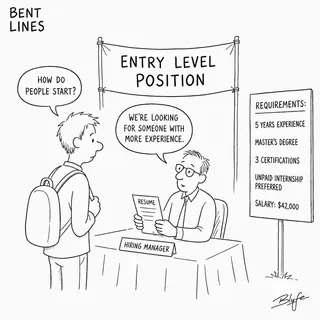
Black-and-white Bent Lines job-fair sketch where an applicant asks how people start and an entry-level posting requires five years of experience, a master’s degree, and three certifications, while preferring an unpaid internship.

Bent Lines BL0010

Entry-Level Position

An entry-level job asks for five years of experience, a master’s degree, three certifications, and prefers a prior unpaid internship.

Bent Lines

Entry-Level Position

Entry level, after five years of experience.

Black-and-white Bent Lines job-fair sketch where an applicant asks how people start and an entry-level posting requires five years of experience, a master’s degree, and three certifications, while preferring an unpaid internship.
Read the visual transcript and evidence receipt

Figure transcript

Main point

The posting uses the language of entry while demanding a long prehistory of qualification. The applicant’s simple question—how do people start?—exposes the circular requirement.

Reading order
  1. An applicant with a backpack stands at a hiring table under an “Entry Level Position” banner.
  2. A requirement board lists experience, education, certifications, internship preference, and salary.
  3. The applicant asks how people start; the hiring manager says they want someone with more experience.
Material labels and values

The requirements are “5 years experience,” “Master’s degree,” “3 certifications,” “Unpaid internship preferred,” and “Salary: $42,000.” The applicant asks, “How do people start?” The hiring manager replies, “We’re looking for someone with more experience.”

Scope and caveats

The requirements and salary are illustrative, not a labor-market average or a quotation from an employer. The drawing does not claim that every entry-level role is structured this way.

Editorial layer

Claim layer: Argued. The argued point is that an entry point becomes less meaningful when employers shift training, credentialing, and early experience entirely onto applicants.

Update and correction status

Status: current. The website uses the publisher-approved BL0010-Entry-Level-Position.png master without changing its pixels, crop, lettering, linework, or Blyfe signature. The imported file was checked on August 28, 2026. Its SHA-256 is 6600f3605de7b37f0fbba8be8f0b164bf56d0965a47860d40f01332acfa3007a. Any visual correction requires a new publisher-approved master and a recorded checksum change.

Evidence receipt

  • External data: None. This Bent Line is an editorial observation and does not present empirical findings.
  • Approved master: BL0010-Entry-Level-Position.png, 1254 × 1254 pixels.
  • Related bent.WTF records: access distortion, institutional fog, household margin.
Black-and-white Bent Lines city sketch of people walking while staring at phones beneath a Recommended for You sign as one person turns toward a Look Up exit and a winding outdoor path.

Bent Lines BL0011

Look Up

A crowd follows a Recommended for You sign while one person leaves the feed to see where the path is going.

Bent Lines

Look Up

One walker leaves the recommendation stream long enough to ask where it goes.

Black-and-white Bent Lines city sketch of people walking while staring at phones beneath a Recommended for You sign as one person turns toward a Look Up exit and a winding outdoor path.
Read the visual transcript and evidence receipt

Figure transcript

Main point

The recommendation system keeps the crowd moving, but one walker stops to inspect the destination. The scene makes attention—not information—the scarce resource.

Reading order
  1. A line of pedestrians walks beneath a billboard reading “Recommended for you,” each looking at a phone.
  2. One pedestrian asks why another stopped scrolling.
  3. The second person turns through a “Look up” opening toward mountains and a winding path, saying, “I wanted to see where I was going.”
Material labels and values

The large sign reads “Recommended for you.” The doorway reads “Look up.” The dialogue reads: “Why’d you stop scrolling?” “I wanted to see where I was going.”

Scope and caveats

The drawing is not a study of recommendation systems, screen time, or user behavior. It does not claim that personalized recommendations are inherently harmful.

Editorial layer

Claim layer: Argued. The argued point is that a system can become very good at supplying the next item while leaving the user’s larger direction unexamined.

Update and correction status

Status: current. The website uses the publisher-approved BL0011-Look-Up.png master without changing its pixels, crop, lettering, linework, or Blyfe signature. The imported file was checked on August 28, 2026. Its SHA-256 is 12bed70990ed58feda0249543b9af6b2617a353437b4656e2935da88c551133c. Any visual correction requires a new publisher-approved master and a recorded checksum change.

Evidence receipt

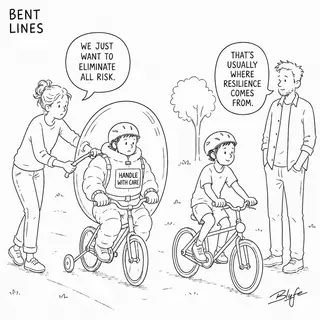
Black-and-white Bent Lines sketch contrasting a heavily padded child on a bicycle with training wheels and a handle against another child riding freely, while adults discuss eliminating risk and building resilience.

Bent Lines BL0012

Eliminate All Risk

One child is wrapped in protective gear and held upright while another learns to ride through ordinary exposure.

Bent Lines

Eliminate All Risk

The safer bicycle never gets the chance to wobble.

Black-and-white Bent Lines sketch contrasting a heavily padded child on a bicycle with training wheels and a handle against another child riding freely, while adults discuss eliminating risk and building resilience.
Read the visual transcript and evidence receipt

Figure transcript

Main point

The adults want to remove every possible danger from one child’s ride. The neighboring child suggests the trade-off: some resilience is learned through bounded exposure rather than perfect protection.

Reading order
  1. A parent steadies a child wearing heavy padding, a helmet, training wheels, and a vest marked “Handle with care.”
  2. The parent says, “We just want to eliminate all risk.”
  3. Another adult watches a second child ride independently and answers, “That’s usually where resilience comes from.”
Material labels and values

The first speech bubble reads “We just want to eliminate all risk.” The second reads “That’s usually where resilience comes from.” The padded vest reads “Handle with care.”

Scope and caveats

This is a metaphor about trade-offs, not safety advice. It does not argue against helmets, supervision, accommodations, or reasonable safeguards, and it does not define an acceptable level of risk.

Editorial layer

Claim layer: Argued. The argued point is that eliminating exposure can also remove opportunities to practice judgment, recovery, and competence.

Update and correction status

Status: current. The website uses the publisher-approved BL0012-Eliminate-All-Risk.png master without changing its pixels, crop, lettering, linework, or Blyfe signature. The imported file was checked on August 28, 2026. Its SHA-256 is ffecfe04ff7a3a04b1f62d5b46652f8b7287e6c66d4fa1dd687ffe2f9795e72c. Any visual correction requires a new publisher-approved master and a recorded checksum change.

Evidence receipt

Black-and-white Bent Lines sketch from inside a car where the navigation screen says recalculated safer route as a passenger points toward the originally chosen road.

Bent Lines BL0013

Safer Route

A navigation system silently replaces the road the passengers chose with a route labeled safer.

Bent Lines

Safer Route

The car is still moving, now on the system’s preferred road.

Black-and-white Bent Lines sketch from inside a car where the navigation screen says recalculated safer route as a passenger points toward the originally chosen road.
Read the visual transcript and evidence receipt

Figure transcript

Main point

The navigation system has changed the route, not simply offered information. The passengers are still moving, but the system’s judgment has displaced their stated choice.

Reading order
  1. Two people sit in a car approaching a fork in the road.
  2. The driver says, “Looks like we have to go this way.” The passenger points toward the other road and says, “But, I wanted to go that way.”
  3. The navigation screen reads “Recalculated — safer route” with an arrow.
Material labels and values

The dialogue reads: “Looks like we have to go this way.” “…but, I wanted to go that way.” The dashboard reads “Recalculated — safer route →.”

Scope and caveats

The scene is hypothetical and does not describe a named navigation product or safety algorithm. It does not argue that route recommendations are useless; it asks when recommendation becomes substitution.

Editorial layer

Claim layer: Argued. The argued point is that protective defaults can quietly move from advising a person to deciding for them.

Update and correction status

Status: current. The website uses the publisher-approved BL0013-Safer-Route.png master without changing its pixels, crop, lettering, linework, or Blyfe signature. The imported file was checked on August 28, 2026. Its SHA-256 is eb1b3fb04ebfd3e05e294beea1c1eb1040a7babd14c607b26b808874fc8e2422. Any visual correction requires a new publisher-approved master and a recorded checksum change.

Evidence receipt

  • External data: None. This Bent Line is an editorial observation and does not present empirical findings.
  • Approved master: BL0013-Safer-Route.png, 1254 × 1254 pixels.
  • Related bent.WTF records: access distortion, institutional fog, sludge.
Black-and-white Bent Lines checkout sketch beneath a Free Shipping sign where the order summary adds handling, processing, and tax while shipping itself is labeled free.

Bent Lines BL0014

Free Shipping

Shipping is listed as free while handling, processing, and tax add almost fifteen dollars to the order.

Bent Lines

Free Shipping

The shipping line says free; three other lines add $14.73.

Black-and-white Bent Lines checkout sketch beneath a Free Shipping sign where the order summary adds handling, processing, and tax while shipping itself is labeled free.
Read the visual transcript and evidence receipt

Figure transcript

Main point

The advertised benefit is technically present: the shipping line says free. The receipt shows why that single line does not describe the price of completing the transaction.

Reading order
  1. A customer holding a parcel stands below a large “Free Shipping” sign.
  2. The customer asks whether the shipping is free; the clerk answers, “Proudly.”
  3. The order summary shows the item price and three other charges before the free shipping line.
Material labels and values

The order summary reads: “Item $49.99,” “Handling $6.99,” “Processing $4.99,” “Tax $2.75,” and “Shipping FREE.” The customer asks, “So the shipping is free?” The clerk says, “Proudly.”

Scope and caveats

The order and fees are illustrative rather than a sourced merchant receipt. The listed non-shipping charges total $14.73, but the image does not display a final amount due or claim that these fee levels are typical.

Editorial layer

Claim layer: Argued. The argued point is that one truthful price claim can still direct attention away from the rest of the transaction cost.

Update and correction status

Status: current. The website uses the publisher-approved BL0014-Free-Shipping.png master without changing its pixels, crop, lettering, linework, or Blyfe signature. The imported file was checked on August 28, 2026. Its SHA-256 is 8e9a17a2b050ee0566c4c58dfff58340b5a15e8e5626dd3737125a5aeb3c8074. Any visual correction requires a new publisher-approved master and a recorded checksum change.

Evidence receipt

  • External data: None. This Bent Line is an editorial observation and does not present empirical findings.
  • Approved master: BL0014-Free-Shipping.png, 1254 × 1254 pixels.
  • Related bent.WTF records: hidden cost, the price tag mask, junk fees total price.
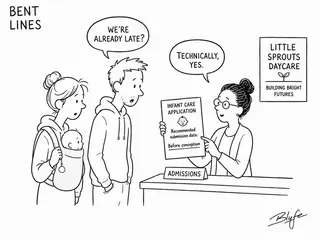
Black-and-white Bent Lines daycare admissions sketch where parents holding an infant are told the recommended application date was before conception.

Bent Lines BL0015

Before Conception

Parents carrying an infant learn that the recommended daycare application date was before conception.

Bent Lines

Before Conception

By the recommended schedule, these parents applied one baby too late.

Black-and-white Bent Lines daycare admissions sketch where parents holding an infant are told the recommended application date was before conception.
Read the visual transcript and evidence receipt

Figure transcript

Main point

The family has arrived with a newborn and discovers that the practical access window opened before they could reasonably apply. The absurd timing makes scarcity visible without needing a queue on the page.

Reading order
  1. Two parents stand at the Little Sprouts Daycare admissions desk with an infant.
  2. One asks, “We’re already late?” The admissions worker answers, “Technically, yes.”
  3. The infant-care application states that the recommended submission date was “Before conception.”
Material labels and values

The wall sign reads “Little Sprouts Daycare — Building bright futures.” The form reads “Infant care application” and “Recommended submission date: Before conception.” The dialogue reads: “We’re already late?” “Technically, yes.”

Scope and caveats

Little Sprouts is fictional, and “before conception” is deliberate comic exaggeration. The drawing does not report a real enrollment deadline, waitlist length, childcare price, or jurisdiction.

Editorial layer

Claim layer: Argued. The argued point is that a service can be nominally available while its timing rules make access unrealistic for ordinary planning.

Update and correction status

Status: current. The website uses the publisher-approved BL0015-Before-Conception.png master without changing its pixels, crop, lettering, linework, or Blyfe signature. The imported file was checked on August 28, 2026. Its SHA-256 is 8ef6db69969b375376648eb50e3f95617e8da2e0e78439a4e7e56f7ca1c0826d. Any visual correction requires a new publisher-approved master and a recorded checksum change.

Evidence receipt

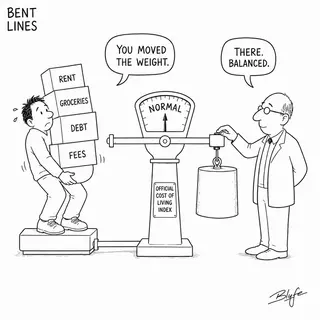
Black-and-white Bent Lines sketch of a person carrying boxes labeled rent, groceries, debt, and fees on one side of a scale while an official balances it with a weight beside an Official Cost of Living Index.

Bent Lines BL0016

Moved the Weight

A household carries rent, groceries, debt, and fees while an official balances the scale with an index weight.

Bent Lines

Moved the Weight

A balanced index does not lighten the household’s boxes.

Black-and-white Bent Lines sketch of a person carrying boxes labeled rent, groceries, debt, and fees on one side of a scale while an official balances it with a weight beside an Official Cost of Living Index.
Read the visual transcript and evidence receipt

Figure transcript

Main point

The official makes the scale read normal by adjusting the other side. The household’s stack of bills has not become lighter; only the measurement has been rebalanced.

Reading order
  1. A person stands on one scale platform holding four boxes.
  2. The boxes are labeled rent, groceries, debt, and fees.
  3. An official moves the counterweight on the opposite side beneath a gauge marked “Normal” and beside an “Official Cost of Living Index.”
Material labels and values

The boxes read “Rent,” “Groceries,” “Debt,” and “Fees.” The scale gauge reads “Normal.” The pedestal reads “Official cost of living index.” The person says, “You moved the weight.” The official replies, “There. Balanced.”

Scope and caveats

This is a conceptual image, not a representation of a specific cost-of-living index, statistical adjustment, or official calculation. The boxes have no numeric values and the counterweight is not a documented methodology.

Editorial layer

Claim layer: Argued. The argued point is that adjusting a model can preserve a stable headline even when the burdens a household is carrying remain visible and concrete.

Update and correction status

Status: current. The website uses the publisher-approved BL0016-Moved-The-Weight.png master without changing its pixels, crop, lettering, linework, or Blyfe signature. The imported file was checked on August 28, 2026. Its SHA-256 is 591c342b7e07309afbb4a1362cf168a4258a17519fe25df9110371e6d05ee264. Any visual correction requires a new publisher-approved master and a recorded checksum change.

Evidence receipt

Black-and-white Bent Lines airport sketch where Flight 417 is labeled On Time above Delay: 2 Hours and Gate: Pending while an employee calls it an expected delay.

Bent Lines BL0017

Expected Delay

A flight remains labeled on time even though the board shows a two-hour delay and a pending gate.

Bent Lines

Expected Delay

The flight keeps its on-time label through a two-hour delay.

Black-and-white Bent Lines airport sketch where Flight 417 is labeled On Time above Delay: 2 Hours and Gate: Pending while an employee calls it an expected delay.
Read the visual transcript and evidence receipt

Figure transcript

Main point

The status word and the underlying facts disagree in plain sight. The employee resolves the contradiction by redefining the delay as expected rather than changing the headline.

Reading order
  1. A traveler with luggage stands at an airport service counter.
  2. The departures board labels Flight 417 “On Time” while also showing a two-hour delay and a pending gate.
  3. The traveler asks how that counts as on time; the employee says it is within the expected delay.
Material labels and values

The board reads “Departures,” “Flight 417,” “On Time,” “Delay: 2 hours,” and “Gate: Pending.” The traveler asks, “How is this on time?” The employee replies, “It’s within the expected delay.”

Scope and caveats

Flight 417 and its status are fictional. The scene does not describe an airline’s formal on-time metric, airport operation, or passenger-rights rule.

Editorial layer

Claim layer: Argued. The argued point is that a reassuring category can survive by absorbing the very condition the category appears to rule out.

Update and correction status

Status: current. The website uses the publisher-approved BL0017-Expected-Delay.png master without changing its pixels, crop, lettering, linework, or Blyfe signature. The imported file was checked on August 28, 2026. Its SHA-256 is 17286a7e6dc7c27c58d5fcd6154b7c3aa628830674cf0e0e9f9c0cc5bfd4a194. Any visual correction requires a new publisher-approved master and a recorded checksum change.

Evidence receipt

  • External data: None. This Bent Line is an editorial observation and does not present empirical findings.
  • Approved master: BL0017-Expected-Delay.png, 1448 × 1086 pixels.
  • Related bent.WTF records: time tax, wait times as cost, institutional fog.
Black-and-white Bent Lines checkout sketch where a self-service machine says Please Wait for Assistance and an employee standing nearby says You're doing great.

Bent Lines BL0018

Self-Service Assistance

A self-service checkout tells the customer to wait for assistance while the nearby employee offers encouragement.

Bent Lines

Self-Service Assistance

The machine needs help; the customer gets encouragement.

Black-and-white Bent Lines checkout sketch where a self-service machine says Please Wait for Assistance and an employee standing nearby says You're doing great.
Read the visual transcript and evidence receipt

Figure transcript

Main point

The customer has been assigned the checkout work but cannot complete it without staff intervention. The employee is present, yet the immediate service offered is encouragement rather than resolution.

Reading order
  1. A customer scans groceries at a station labeled “Self-Service Assistance.”
  2. The machine displays “Please wait for assistance.”
  3. An employee stands nearby and says, “You’re doing great.”
Material labels and values

The overhead sign reads “Self-Service Assistance.” The screen reads “Please wait for assistance.” The employee’s speech bubble reads “You’re doing great.”

Scope and caveats

This is an editorial scene, not a measurement of checkout staffing, error rates, or wait times. It does not claim that all self-service systems fail or that staff never assist.

Editorial layer

Claim layer: Argued. The argued point is that self-service can transfer labor to the customer without eliminating the need for the institution’s own intervention.

Update and correction status

Status: current. The website uses the publisher-approved BL0018-Self-Service-Assistance.png master without changing its pixels, crop, lettering, linework, or Blyfe signature. The imported file was checked on August 28, 2026. Its SHA-256 is b536b991db100a7fb78ef91a41cba72401c82a2f3db485f9aa23ffbdb40e392d. Any visual correction requires a new publisher-approved master and a recorded checksum change.

Evidence receipt

  • External data: None. This Bent Line is an editorial observation and does not present empirical findings.
  • Approved master: BL0018-Self-Service-Assistance.png, 1254 × 1254 pixels.
  • Related bent.WTF records: sludge, administrative burden, time tax.
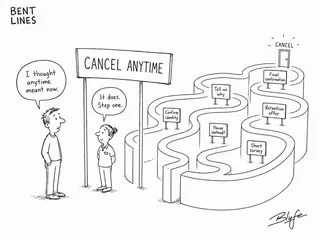
Black-and-white Bent Lines sketch where a Cancel Anytime entrance leads into a long winding process labeled confirm identity, tell us why, pause instead, survey, retention offer, final confirmation, and cancel.

Bent Lines BL0019

Cancel Anytime

A sign promises cancellation at any time, but the exit sits beyond identity checks, surveys, offers, pauses, and confirmations.

Bent Lines

Cancel Anytime

Anytime begins a long way from the exit.

Black-and-white Bent Lines sketch where a Cancel Anytime entrance leads into a long winding process labeled confirm identity, tell us why, pause instead, survey, retention offer, final confirmation, and cancel.
Read the visual transcript and evidence receipt

Figure transcript

Main point

The promise and the mechanism are both visible. Cancellation is technically available, but reaching it requires navigating a designed sequence of retention and verification steps.

Reading order
  1. A customer says, “I thought anytime meant now,” beneath a “Cancel Anytime” sign.
  2. An employee answers, “It does. Step one.”
  3. A long maze leads through identity confirmation, reasons, a pause option, survey, retention offer, final confirmation, and finally cancel.
Material labels and values

The process labels read “Confirm identity,” “Tell us why,” “Pause instead?,” “Short survey,” “Retention offer,” “Final confirmation,” and “Cancel.” The dialogue reads: “I thought anytime meant now.” “It does. Step one.”

Scope and caveats

The cancellation path is illustrative and is not copied from a named service or tested interface. The drawing does not estimate how many steps real services require.

Editorial layer

Claim layer: Argued. The argued point is that a formal right to cancel can coexist with a process that adds delay and friction before the exit.

Update and correction status

Status: current. The website uses the publisher-approved BL0019-Cancel-Anytime.png master without changing its pixels, crop, lettering, linework, or Blyfe signature. The imported file was checked on August 28, 2026. Its SHA-256 is 2bd9eeab059940362650315c8e0b95c9c5ea6603c0973e612c2e7f299710163f. Any visual correction requires a new publisher-approved master and a recorded checksum change.

Evidence receipt

  • External data: None. This Bent Line is an editorial observation and does not present empirical findings.
  • Approved master: BL0019-Cancel-Anytime.png, 1447 × 1087 pixels.
  • Related bent.WTF records: sludge, administrative burden, time tax.
Black-and-white Bent Lines sketch of a person at a laptop surrounded by account, email, password, terms, preferences, code, and PDF prompts while saying paperless was supposed to be simpler.

Bent Lines BL0020

Paperless Billing

Paperless billing replaces an envelope with account creation, email verification, codes, terms, resets, preferences, and a PDF download.

Bent Lines

Paperless Billing

Paperless moved the work from the mailbox to the account holder.

Black-and-white Bent Lines sketch of a person at a laptop surrounded by account, email, password, terms, preferences, code, and PDF prompts while saying paperless was supposed to be simpler.
Read the visual transcript and evidence receipt

Figure transcript

Main point

The envelope has disappeared, but the work has multiplied into digital tasks. The scene separates material efficiency from the customer’s actual effort.

Reading order
  1. A person sits at a laptop showing “Paperless Billing — Create account to continue.”
  2. Pop-up tasks surround the screen: account, email, preferences, code, password, terms, reset, and PDF download.
  3. The person says, “I thought paperless meant simpler,” while a final bubble says, “Almost there.”
Material labels and values

The laptop reads “Paperless billing — Create account to continue.” The surrounding prompts read “Create account,” “Verify email,” “Update preferences,” “Enter code,” “Password expired,” “Download PDF,” “Accept terms,” and “Reset password.” The dialogue reads “I thought paperless meant simpler.” “Almost there.”

Scope and caveats

The workflow is an editorial composite, not a reproduction of a named billing portal or a count of typical paperless-billing steps. It does not dispute the material and delivery benefits of electronic records.

Editorial layer

Claim layer: Argued. The argued point is that digitizing a document can reduce paper while transferring setup, authentication, retrieval, and maintenance work to the customer.

Update and correction status

Status: current. The website uses the publisher-approved BL0020-Paperless-Billing.png master without changing its pixels, crop, lettering, linework, or Blyfe signature. The imported file was checked on August 28, 2026. Its SHA-256 is edeea3d507816c06c2ee24269f4d72821b8318e71e4f536b56711d6587c7fcbc. Any visual correction requires a new publisher-approved master and a recorded checksum change.

Evidence receipt

  • External data: None. This Bent Line is an editorial observation and does not present empirical findings.
  • Approved master: BL0020-Paperless-Billing.png, 1254 × 1254 pixels.
  • Related bent.WTF records: sludge, administrative burden, time tax.
Black-and-white Bent Lines sketch of a shopper in a freezer aisle holding a tiny package labeled Family Size and asking, “Whose family?”

Bent Lines BL0021

Family Size

A shopper holds a very small package marked Family Size and asks the question printed labels usually avoid.

Bent Lines

Family Size

The package kept the family. The food got smaller.

Black-and-white Bent Lines sketch of a shopper in a freezer aisle holding a tiny package labeled Family Size and asking, “Whose family?”
Read the visual transcript and evidence receipt

Figure transcript

Main point

A shopper finds a package whose “Family Size” label has outgrown the amount inside it. The drawing treats the label as a measurement claim that stayed put while the package became too small to carry it convincingly.

Reading order
  1. A freezer shelf displays boxes marked “Chicken Nuggets” and “Mega Pizza” above a $6.99 shelf tag.
  2. The shopper lifts a much smaller package labeled “Family Size.”
  3. He looks at it and asks, “Whose family?”
Material labels and values

Visible text includes “Chicken Nuggets,” “Mega Pizza,” $6.99, “Family Size,” and the speech bubble “Whose family?” The shopper carries an empty basket beside an open freezer case.

Scope and caveats

This is an editorial scene, not a documented package-size comparison. It does not identify a product, manufacturer, former quantity, current quantity, or measured prevalence of shrinkflation.

Editorial layer

Claim layer: Argued. The joke is that a marketing label can remain generous after the underlying quantity no longer feels generous.

Update and correction status

Status: current. The website uses the publisher-approved BL0021-Family-Size.png master without changing its pixels, crop, lettering, linework, or Blyfe signature. The imported file was checked on August 28, 2026. Its SHA-256 is 27da918ccef989d9995afa0b04387163880af3504a8466d2b5e9d8527b7247ed. Any visual correction requires a new publisher-approved master and a recorded checksum change.

Evidence receipt

  • External data: None. This Bent Line is an editorial observation and does not present empirical findings.
  • Approved master: BL0021-Family-Size.png, 1254 × 1254 pixels.
  • Related bent.WTF records: measurement failure, hidden cost, cost migration.
Black-and-white Bent Lines sketch of a viewer staring at a television that totals six streaming charges at $143.87 per month, with internet not included.

Bent Lines BL0022

Cut the Cord

A viewer who left cable behind confronts a six-service streaming total before the internet bill.

Bent Lines

Cut the Cord

The cord was cut. The bundle grew back in pieces.

Black-and-white Bent Lines sketch of a viewer staring at a television that totals six streaming charges at $143.87 per month, with internet not included.
Read the visual transcript and evidence receipt

Figure transcript

Main point

The viewer escaped one bundled television bill and rebuilt another from separate subscriptions. The screen adds the pieces before noting that the internet connection is still outside the total.

Reading order
  1. A seated viewer studies a television labeled “Monthly Streaming Total.”
  2. Six fictional service charges add to $143.87; a line beneath says “Internet not included.”
  3. The viewer says, “I thought I cut the cord.”
Material labels and values

The television lists: “Netflicks $22.99,” “Hulish $17.99,” “Dismeh+ $15.99,” “Sports Add-On $24.99,” “Live TV Bundle $39.99,” and “No Ads Upgrade $22.92.” The displayed total is $143.87. The final line reads “Internet not included.”

Scope and caveats

The service names and prices are fictional. The arithmetic is internal to the joke, not a market average, consumer survey, current price comparison, or claim about what any named household pays.

Editorial layer

Claim layer: Argued. The argued point is that unbundling can reproduce a bundle when separate recurring charges accumulate around the same use.

Update and correction status

Status: current. The website uses the publisher-approved BL0022-Cut-The-Cord.png master without changing its pixels, crop, lettering, linework, or Blyfe signature. The imported file was checked on August 28, 2026. Its SHA-256 is 0755543f3e0b2b27465531180a443131ddd54fb9dd001adc16b2f011e803c793. Any visual correction requires a new publisher-approved master and a recorded checksum change.

Evidence receipt

  • External data: None. The figures are invented parts of an editorial scene and are not empirical findings.
  • Approved master: BL0022-Cut-The-Cord.png, 1448 × 1086 pixels.
  • Related bent.WTF records: hidden cost, household margin, cost migration.
Black-and-white Bent Lines sketch of a tired man walking on a treadmill labeled Minimum Payment while a distant sign says Paid Off.

Bent Lines BL0023

Minimum Payment

A minimum payment becomes a treadmill whose payoff horizon is technically somewhere ahead.

Bent Lines

Minimum Payment

The payment keeps moving. The finish line mostly waits.

Black-and-white Bent Lines sketch of a tired man walking on a treadmill labeled Minimum Payment while a distant sign says Paid Off.
Read the visual transcript and evidence receipt

Figure transcript

Main point

A debtor makes the required payment and remains on a treadmill. The destination exists, but the machine gives no useful sense of when the walker will reach it.

Reading order
  1. A tired man walks left on a treadmill labeled “Minimum Payment.”
  2. His statement says “Minimum Due: $38” and “Estimated payoff: Eventually.”
  3. He asks, “So this keeps me caught up?” The treadmill answers, “Technically.” A distant sign reads “Paid Off.”
Material labels and values

The statement shows a minimum due of $38 and an estimated payoff of “Eventually.” The machine is labeled “Minimum Payment.” The speech bubbles read “So this keeps me caught up?” and “Technically.” The destination sign reads “Paid Off.”

Scope and caveats

This is an editorial metaphor, not a repayment disclosure. The $38 amount is illustrative. The drawing does not specify a balance, interest rate, fee schedule, compounding method, repayment term, or the rules of any lender.

Editorial layer

Claim layer: Argued. The scene separates staying contractually current from making meaningful progress toward the end of a debt.

Update and correction status

Status: current. The website uses the publisher-approved BL0023-Minimum-Payment.png master without changing its pixels, crop, lettering, linework, or Blyfe signature. The imported file was checked on August 28, 2026. Its SHA-256 is 2cc16d44135bd8a71c3b8b02cb8a370f2ab8df6b352079186c88aaf40d7dae0d. Any visual correction requires a new publisher-approved master and a recorded checksum change.

Evidence receipt

  • External data: None. The amount and payoff language are illustrative parts of an editorial scene.
  • Approved master: BL0023-Minimum-Payment.png, 1254 × 1254 pixels.
  • Related bent.WTF records: household margin, hidden cost, cost migration.
Black-and-white Bent Lines sketch of a person facing a towering stack labeled Updated Terms, with an I Agree box at the bottom and a sign saying Please agree first.

Bent Lines BL0024

Updated Terms

A person asks what changed and receives a wall of updated terms that cannot be inspected until accepted.

Bent Lines

Updated Terms

The explanation is behind the agreement.

Black-and-white Bent Lines sketch of a person facing a towering stack labeled Updated Terms, with an I Agree box at the bottom and a sign saying Please agree first.
Read the visual transcript and evidence receipt

Figure transcript

Main point

The person wants to know what changed. The process presents a tower of terms and places the agreement control at the bottom, then makes agreement the condition for getting an answer.

Reading order
  1. A person looks up at a very tall stack headed “Updated Terms.”
  2. He asks, “What changed?”
  3. A callout beside the stack says, “Please agree first.” At the bottom is an unchecked box labeled “I agree.”
Material labels and values

Visible text reads “Updated Terms,” “What changed?”, “Please agree first,” and “I agree.” The terms are drawn as a stack much taller than the reader.

Scope and caveats

This is an editorial exaggeration, not a reproduction or measurement of a particular contract. It does not claim that every provider with updated terms prevents review, or that clicking an agreement box is legally valid in every jurisdiction or circumstance.

Editorial layer

Claim layer: Argued. The joke is that procedural consent can be easier to collect than informed understanding.

Update and correction status

Status: current. The website uses the publisher-approved BL0024-Updated-Terms.png master without changing its pixels, crop, lettering, linework, or Blyfe signature. The imported file was checked on August 28, 2026. Its SHA-256 is d0e2b2809a8234cd0972bd2770f41dd858a6c92cb721548257b1ac2cdf95932f. Any visual correction requires a new publisher-approved master and a recorded checksum change.

Evidence receipt

  • External data: None. This Bent Line is an editorial observation and does not present empirical findings.
  • Approved master: BL0024-Updated-Terms.png, 1254 × 1254 pixels.
  • Related bent.WTF records: administrative burden, sludge, access distortion.
Black-and-white Bent Lines sketch of shoppers queued behind a stalled Express Self-Checkout while a chained cashier station says Cashier back tomorrow.

Bent Lines BL0025

Express Lane

A long line waits at an express self-checkout while the staffed register promises to return tomorrow.

Bent Lines

Express Lane

The lane is express. The waiting is self-service.

Black-and-white Bent Lines sketch of shoppers queued behind a stalled Express Self-Checkout while a chained cashier station says Cashier back tomorrow.
Read the visual transcript and evidence receipt

Figure transcript

Main point

The store calls the lane express while customers supply the labor and wait for the machine. The staffed register is closed, so the faster route has no competing route left.

Reading order
  1. A sign marks an “Express Self-Checkout” for “15 items or fewer.”
  2. A shopper at the front of a long queue asks, “This is express?”
  3. The checkout screen answers, “Eventually.” A chained cashier station carries a “Cashier back tomorrow” sign.
Material labels and values

Visible text reads “Express Self-Checkout,” “15 items or fewer,” “This is express?”, “Eventually,” and “Cashier back tomorrow.” The queue contains shoppers with baskets and phones.

Scope and caveats

This is an editorial scene, not a measured wait-time study or staffing survey. It does not claim that every self-checkout is slower than a cashier or that self-service never shortens a transaction.

Editorial layer

Claim layer: Argued. The drawing treats “express” as a label whose meaning changes when the customer performs the work and the only machine develops a delay.

Update and correction status

Status: current. The website uses the publisher-approved BL0025-Express-Lane.png master without changing its pixels, crop, lettering, linework, or Blyfe signature. The imported file was checked on August 28, 2026. Its SHA-256 is 486dcdc7b6ba05143b948a6e862092e6fb200593e27687039b48c34728732ef2. Any visual correction requires a new publisher-approved master and a recorded checksum change.

Evidence receipt

  • External data: None. This Bent Line is an editorial observation and does not present empirical findings.
  • Approved master: BL0025-Express-Lane.png, 1254 × 1254 pixels.
  • Related bent.WTF records: time tax, administrative burden, sludge.
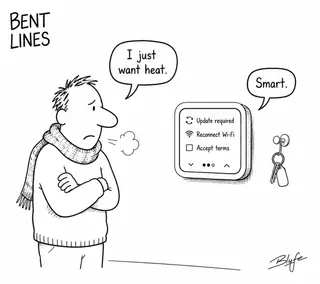
Black-and-white Bent Lines sketch of a shivering person facing a smart thermostat that requires an update, Wi-Fi reconnection, and accepted terms before providing heat.

Bent Lines BL0026

Smart Thermostat

A cold homeowner asks for heat while the thermostat asks for an update, Wi-Fi, and new terms.

Bent Lines

Smart Thermostat

The thermostat understands heat. First it needs paperwork.

Black-and-white Bent Lines sketch of a shivering person facing a smart thermostat that requires an update, Wi-Fi reconnection, and accepted terms before providing heat.
Read the visual transcript and evidence receipt

Figure transcript

Main point

The thermostat’s basic physical job is trapped behind its digital maintenance work. The cold person asks for heat; the device answers by describing the setup it wants from the person.

Reading order
  1. A scarf-wearing person folds his arms and exhales a visible puff of cold air.
  2. He says, “I just want heat.”
  3. The thermostat shows “Update required,” “Reconnect Wi-Fi,” and an unchecked “Accept terms” item, then replies, “Smart.”
Material labels and values

The two speech bubbles read “I just want heat” and “Smart.” The device lists “Update required,” “Reconnect Wi-Fi,” and “Accept terms.” A set of house keys hangs nearby.

Scope and caveats

This is an editorial scene, not a test of a particular thermostat. It does not claim that every connected thermostat blocks manual operation, or that updates, authentication, connectivity, and terms never serve security or reliability purposes.

Editorial layer

Claim layer: Argued. The joke tests whether added intelligence improves the task when the added system creates new conditions between the user and the heat.

Update and correction status

Status: current. The website uses the publisher-approved BL0026-Smart-Thermostat.png master without changing its pixels, crop, lettering, linework, or Blyfe signature. The imported file was checked on August 28, 2026. Its SHA-256 is a90a57ada198ca9689158d12a63b15c25da03b79213a7d7545f4b67da3dbc94d. Any visual correction requires a new publisher-approved master and a recorded checksum change.

Evidence receipt

  • External data: None. This Bent Line is an editorial observation and does not present empirical findings.
  • Approved master: BL0026-Smart-Thermostat.png, 1331 × 1181 pixels.
  • Related bent.WTF records: administrative burden, sludge, access distortion.
Black-and-white Bent Lines sketch of a patient and doctor beside a large Prior Authorization stamp and a Status Pending sign.

Bent Lines BL0027

Prior Authorization

A patient learns that a doctor's approval begins another approval process rather than ending one.

Bent Lines

Prior Authorization

The doctor approved it. The approval did not.

Black-and-white Bent Lines sketch of a patient and doctor beside a large Prior Authorization stamp and a Status Pending sign.
Read the visual transcript and evidence receipt

Figure transcript

Main point

The doctor’s clinical approval does not complete the patient’s path. It hands the decision to a second process, represented by an oversized stamp whose current answer is still pending.

Reading order
  1. A patient sits on an examination table and asks, “So my doctor approved it?”
  2. The doctor holds a paper marked “Doctor Approved” with a checkmark.
  3. She answers, “Now ask someone else.” A large stamp reads “Prior Authorization,” and a desk sign reads “Status: Pending.”
Material labels and values

Visible text includes “So my doctor approved it?”, “Now ask someone else,” “Doctor Approved,” “Prior Authorization,” and “Status: Pending.” The room includes an examination table, medical cabinet, framed credential, tablet, and stamp.

Scope and caveats

This is an editorial scene, not a claim that every treatment requires prior authorization or that every request is delayed or denied. It does not identify a health plan, procedure, clinical standard, jurisdiction, or decision outcome.

Editorial layer

Claim layer: Argued. The drawing separates a clinician’s approval from the administrative authority that determines whether the covered path may continue.

Update and correction status

Status: current. The website uses the publisher-approved BL0027-Prior-Authorization.png master without changing its pixels, crop, lettering, linework, or Blyfe signature. The imported file was checked on August 28, 2026. Its SHA-256 is 0cdc19db4c42b8a84ab1b11d2083b2884033bce57702c33963e1642eeabde5d3. Any visual correction requires a new publisher-approved master and a recorded checksum change.

Evidence receipt

  • External data: None. This Bent Line is an editorial observation and does not present empirical findings.
  • Approved master: BL0027-Prior-Authorization.png, 1254 × 1254 pixels.
  • Related bent.WTF records: access distortion, administrative burden, time tax.
Black-and-white Bent Lines sketch of a person holding a toothbrush beside an enormous paper-filled box labeled Eco-Friendly Packaging.

Bent Lines BL0028

Oversized Packaging

A toothbrush arrives inside a box overflowing with packing paper under an eco-friendly label.

Bent Lines

Oversized Packaging

The box is sustainable. There is simply a lot of it.

Black-and-white Bent Lines sketch of a person holding a toothbrush beside an enormous paper-filled box labeled Eco-Friendly Packaging.
Read the visual transcript and evidence receipt

Figure transcript

Main point

The package makes a narrow sustainability claim about its materials while avoiding the obvious question raised by its size. The label may be true and still leave the larger measure untouched.

Reading order
  1. A person holds a toothbrush in a small retail package and asks, “Which part?”
  2. An enormous open box overflows with crumpled paper and padding.
  3. The box answers, “The label.” Its front reads “Eco-Friendly Packaging,” while a shipping label says “Made with sustainable ink.”
Material labels and values

Visible text reads “Which part?”, “The label,” “Eco-Friendly Packaging,” and “Made with sustainable ink.” The small product is a toothbrush. Packing material spills from the oversized box onto the floor.

Scope and caveats

This is an editorial scene, not a lifecycle assessment. It does not measure the amount, source, recyclability, emissions, or comparative environmental impact of any real package or ink.

Editorial layer

Claim layer: Argued. The joke shows how a narrow favorable label can draw attention away from the scale of the object carrying it.

Update and correction status

Status: current. The website uses the publisher-approved BL0028-Oversized-Packaging.png master without changing its pixels, crop, lettering, linework, or Blyfe signature. The imported file was checked on August 28, 2026. Its SHA-256 is 82cb65c1952290e1545b322728505808b889635b1f4a64fe60339630b97cf0bf. Any visual correction requires a new publisher-approved master and a recorded checksum change.

Evidence receipt

  • External data: None. This Bent Line is an editorial observation and does not present empirical findings.
  • Approved master: BL0028-Oversized-Packaging.png, 1254 × 1254 pixels.
  • Related bent.WTF records: measurement failure, institutional fog, hidden cost.
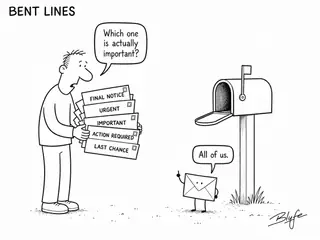
Black-and-white Bent Lines sketch of a person holding envelopes labeled Final Notice, Urgent, Important, Action Required, and Last Chance while a small envelope says they all matter.

Bent Lines BL0029

Actually Important

A stack of escalating notices asks the envelope itself to identify which one still deserves attention.

Bent Lines

Actually Important

Every envelope found the red flag. None found a priority.

Black-and-white Bent Lines sketch of a person holding envelopes labeled Final Notice, Urgent, Important, Action Required, and Last Chance while a small envelope says they all matter.
Read the visual transcript and evidence receipt

Figure transcript

Main point

Every notice uses emergency language, so the labels stop helping the recipient decide what deserves attention first. The mail itself insists that nothing can be deprioritized.

Reading order
  1. A person carries a stack of envelopes labeled with escalating priority words.
  2. He asks, “Which one is actually important?”
  3. A small personified envelope beside an open mailbox answers, “All of us.”
Material labels and values

The visible envelopes are labeled “Final Notice,” “Urgent,” “Important,” “Action Required,” and “Last Chance.” The speech bubbles read “Which one is actually important?” and “All of us.”

Scope and caveats

This is an editorial scene, not a sample of actual mail or a claim that the five labels are always misused. It does not establish which notices are legally significant, time-sensitive, deceptive, or safe to ignore.

Editorial layer

Claim layer: Argued. The scene treats urgency inflation as a measurement failure: once every message claims maximum importance, the words no longer rank the work.

Update and correction status

Status: current. The website uses the publisher-approved BL0029-Actually-Important.png master without changing its pixels, crop, lettering, linework, or Blyfe signature. The imported file was checked on August 28, 2026. Its SHA-256 is 32295f17ab29211748405d29b95149d8c90e6eead773a2d139e010f6581eeac8. Any visual correction requires a new publisher-approved master and a recorded checksum change.

Evidence receipt

  • External data: None. This Bent Line is an editorial observation and does not present empirical findings.
  • Approved master: BL0029-Actually-Important.png, 1448 × 1086 pixels.
  • Related bent.WTF records: administrative burden, sludge, institutional fog.
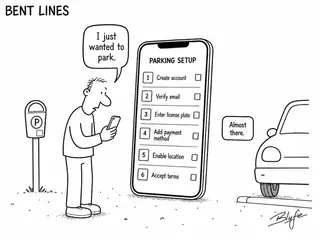
Black-and-white Bent Lines sketch of a driver beside a parking meter facing a giant phone with six parking-setup steps.

Bent Lines BL0030

Parking App

A driver reaches the parking space and discovers six setup steps between the curb and the meter.

Bent Lines

Parking App

The car is parked. The account is still arriving.

Black-and-white Bent Lines sketch of a driver beside a parking meter facing a giant phone with six parking-setup steps.
Read the visual transcript and evidence receipt

Figure transcript

Main point

The driver has completed the physical task of parking but cannot complete the payment until he builds the account around it. The car’s “Almost there” reply turns the setup work into part of the parking event.

Reading order
  1. A driver stands between a parking meter and his parked car and says, “I just wanted to park.”
  2. A giant phone headed “Parking Setup” presents six unchecked tasks.
  3. The car answers, “Almost there.”
Material labels and values

The setup list reads: “1 Create account,” “2 Verify email,” “3 Enter license plate,” “4 Add payment method,” “5 Enable location,” and “6 Accept terms.” The other speech bubble reads “Almost there.” A parking meter is marked with a P.

Scope and caveats

This is an editorial scene, not a review of a particular parking system. It does not claim that every parking app requires all six steps, that no app preserves prior information, or that digital payment never improves availability or enforcement.

Editorial layer

Claim layer: Argued. The drawing counts account setup, identity confirmation, data entry, payment configuration, location permission, and consent as work transferred into a small transaction.

Update and correction status

Status: current. The website uses the publisher-approved BL0030-Parking-App.png master without changing its pixels, crop, lettering, linework, or Blyfe signature. The imported file was checked on August 28, 2026. Its SHA-256 is 0a9a80ef92708196089f8d7958853564c98127490fbb24e00d165fb08cbff5fb. Any visual correction requires a new publisher-approved master and a recorded checksum change.

Evidence receipt

  • External data: None. This Bent Line is an editorial observation and does not present empirical findings.
  • Approved master: BL0030-Parking-App.png, 1448 × 1086 pixels.
  • Related bent.WTF records: administrative burden, time tax, access distortion.
Black-and-white Bent Lines sketch of a person facing a giant preferences screen where five data and service settings are on and Control is off.

Bent Lines BL0031

Default Settings

A preferences screen turns on tracking, notifications, renewal, offers, and data sharing while leaving control off.

Bent Lines

Default Settings

Everything is on by default, including the answer.

Black-and-white Bent Lines sketch of a person facing a giant preferences screen where five data and service settings are on and Control is off.
Read the visual transcript and evidence receipt

Figure transcript

Main point

The interface calls the panel “Your Preferences,” but it has already chosen the settings most useful to the system. The only preference left off is the one labeled control.

Reading order
  1. A person with a backpack faces a giant panel titled “Your Preferences.”
  2. Tracking, notifications, auto-renew, personalized offers, and share data are all switched on; control is switched off.
  3. The person asks, “So I’m in control?” The panel answers, “By default.”
Material labels and values

The panel reads “Your Preferences.” Its switches show “Tracking — On,” “Notifications — On,” “Auto-Renew — On,” “Personalized Offers — On,” “Share Data — On,” and “Control — Off.” The speech bubbles read “So I’m in control?” and “By default.”

Scope and caveats

This is an editorial interface, not a reproduction of a named service. It does not claim that every default is unlawful or harmful, or that tracking, notifications, renewal, personalization, and data sharing always lack user controls.

Editorial layer

Claim layer: Argued. The scene asks whether a preference remains a choice when the consequential settings have already been selected for the user.

Update and correction status

Status: current. The website uses the final publisher-approved BL0031-Default-Settings.png alignment master without changing its pixels, crop, lettering, linework, or Blyfe signature. The imported file was checked on August 28, 2026. Its SHA-256 is 7d43f8bd863695d42ff0e310e73785087fc9bcfcc36bde813687113948f35596. Any visual correction requires a new publisher-approved master and a recorded checksum change.

Evidence receipt

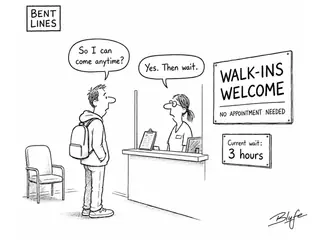
Black-and-white Bent Lines sketch of a walk-in counter with a Walk-Ins Welcome sign and a separate Current wait: 3 hours notice.

Bent Lines BL0032

Walk-Ins Welcome

A no-appointment welcome sign promises immediate entry beside a current wait of three hours.

Bent Lines

Walk-Ins Welcome

No appointment is required. Only the afternoon.

Black-and-white Bent Lines sketch of a walk-in counter with a Walk-Ins Welcome sign and a separate Current wait: 3 hours notice.
Read the visual transcript and evidence receipt

Figure transcript

Main point

The sign describes access in terms of whether an appointment is required. The smaller sign measures the cost of using that access: a three-hour wait.

Reading order
  1. A person approaches a service counter and asks, “So I can come anytime?”
  2. The worker answers, “Yes. Then wait.”
  3. The large sign reads “Walk-Ins Welcome — No Appointment Needed.” The smaller sign reads “Current wait: 3 hours.”
Material labels and values

Visible text reads “So I can come anytime?”, “Yes. Then wait,” “Walk-Ins Welcome,” “No Appointment Needed,” and “Current wait: 3 hours.” An empty waiting-room chair stands beside the counter.

Scope and caveats

The three-hour wait is illustrative, not a measured wait at a named clinic, office, or business. The drawing does not claim that walk-in service always takes longer than scheduled service or that the model lacks practical benefits.

Editorial layer

Claim layer: Argued. The scene separates formal availability from usable access once the reader’s time is counted.

Update and correction status

Status: current. The website uses the final publisher-approved BL0032-Walk-Ins-Welcome.png alignment master. Its 1448 × 1086 presentation normalization removed only unused whitespace and added white side margins; the retained drawing was not rescaled or redrawn. The imported file was checked on August 28, 2026. Its SHA-256 is afda9e09bd201b4042af6401b1781aad2fe72c5dd096b6d8ba8aa3866c001b48. Any visual correction requires a new publisher-approved master and a recorded checksum change.

Evidence receipt

  • External data: None. The three-hour wait is an illustrative part of an editorial scene.
  • Approved master: BL0032-Walk-Ins-Welcome.png, 1448 × 1086 pixels.
  • Related bent.WTF records: time tax, access distortion, institutional fog.
Black-and-white Bent Lines sketch of a diner asking for a menu while a server points to a QR code and says only his phone has one.

Bent Lines BL0033

QR Code Menu

A diner asks for a menu and learns that access depends on his phone's battery and camera.

Bent Lines

QR Code Menu

The restaurant has a menu. The customer's phone has custody.

Black-and-white Bent Lines sketch of a diner asking for a menu while a server points to a QR code and says only his phone has one.
Read the visual transcript and evidence receipt

Figure transcript

Main point

The restaurant has moved the menu from a shared object to a dependency on the diner’s device. The food has not changed, but the route to reading about it now requires a working phone.

Reading order
  1. A diner with a phone showing 8% battery asks, “Do you have a menu?”
  2. The server answers, “Only if your phone does.”
  3. A table sign reads “View Menu” and “Scan Here” around a QR code.
Material labels and values

Visible text reads “Do you have a menu?”, “Only if your phone does,” “View Menu,” and “Scan Here.” The diner’s phone shows 8%. The table holds the QR placard and a drinking glass.

Scope and caveats

This is an editorial scene, not a survey of restaurant practices or device access. It does not claim that QR menus are always inaccessible or that they never improve updates, translation, hygiene, or cost.

Editorial layer

Claim layer: Argued. The drawing treats battery, connectivity, camera access, and device fluency as new conditions attached to reading an ordinary menu.

Update and correction status

Status: current. The website uses the final publisher-approved BL0033-QR-Code-Menu.png alignment master without changing its pixels, crop, lettering, linework, or Blyfe signature. The imported file was checked on August 28, 2026. Its SHA-256 is c05edc15fabb294a918a366fec56fb5dfe9ad36834ac76c2b24e2d4526136f50. Any visual correction requires a new publisher-approved master and a recorded checksum change.

Evidence receipt

  • External data: None. The 8% battery display is an illustrative scene detail, not an empirical finding.
  • Approved master: BL0033-QR-Code-Menu.png, 1448 × 1086 pixels.
  • Related bent.WTF records: access distortion, administrative burden, time tax.
Black-and-white Bent Lines sketch of a frustrated person at a laptop showing a Prove You're Human image grid and an I'm Not a Robot checkbox.

Bent Lines BL0034

Human Verification

A person completing a human-verification puzzle is less certain of the answer by the time the machine asks.

Bent Lines

Human Verification

The machine wants proof. The human would like some too.

Black-and-white Bent Lines sketch of a frustrated person at a laptop showing a Prove You're Human image grid and an I'm Not a Robot checkbox.
Read the visual transcript and evidence receipt

Figure transcript

Main point

The machine assigns a recognition test to prove that the user is human. The person’s answer suggests that the verification process itself has become the less human part of the exchange.

Reading order
  1. A person leans toward a laptop beside a mug and notebook.
  2. The screen says “Prove You’re Human” above a nine-square image grid and a checked “I’m Not a Robot” box.
  3. The person says, “I was, before this.”
Material labels and values

The laptop shows “Prove You’re Human” and “I’m Not a Robot.” Nine blank selection squares appear above the checked box. The speech bubble reads “I was, before this.”

Scope and caveats

This is an editorial scene, not a security evaluation. It does not claim that all human-verification systems use image grids, that the controls never prevent abuse, or that accessibility and privacy implementations are identical.

Editorial layer

Claim layer: Argued. The joke counts the user’s time, attention, and frustration as costs of a security process designed around the system’s uncertainty.

Update and correction status

Status: current. The website uses the final publisher-approved BL0034-Human-Verification.png alignment master without changing its pixels, crop, lettering, linework, or Blyfe signature. The imported file was checked on August 28, 2026. Its SHA-256 is b15d8ba7d90ccdd8d48ca4601fe175094c05a8c0142fa430a55d2fc8fe01b783. Any visual correction requires a new publisher-approved master and a recorded checksum change.

Evidence receipt

  • External data: None. This Bent Line is an editorial observation and does not present empirical findings.
  • Approved master: BL0034-Human-Verification.png, 1448 × 1086 pixels.
  • Related bent.WTF records: administrative burden, time tax, sludge.
Black-and-white Bent Lines sketch of a person holding a page beside a printer whose screen says Cannot print. Cyan low.

Bent Lines BL0035

Printer Needs Cyan

A printer refuses a black-and-white page because the missing color matters to the machine more than to the document.

Bent Lines

Printer Needs Cyan

The page is black and white. The printer has feelings.

Black-and-white Bent Lines sketch of a person holding a page beside a printer whose screen says Cannot print. Cyan low.
Read the visual transcript and evidence receipt

Figure transcript

Main point

The requested page needs black ink. The printer blocks the task because a different supply is low, making the machine’s internal rule more important than the visible job.

Reading order
  1. A person holds a plain sheet of paper and looks at a printer.
  2. The printer screen says “Cannot print. Cyan low.”
  3. The person says, “It’s black and white.” The printer answers, “Emotionally, no.”
Material labels and values

Visible text reads “Cannot print. Cyan low,” “It’s black and white,” and “Emotionally, no.” A stack of paper sits beside the printer.

Scope and caveats

This is an editorial scene, not a technical claim about every printer or print mode. Some devices use color supplies for maintenance, calibration, or composite output. The drawing does not evaluate those designs or identify a manufacturer.

Editorial layer

Claim layer: Argued. The joke shows a dependency that is legible to the machine but unrelated to the user’s understanding of the requested output.

Update and correction status

Status: current. The website uses the final publisher-approved BL0035-Printer-Needs-Cyan.png alignment master without changing its pixels, crop, lettering, linework, or Blyfe signature. The imported file was checked on August 28, 2026. Its SHA-256 is 943616a2bb25657dbfa53da0960f31690e4966cf1da01f5b75299e1815048365. Any visual correction requires a new publisher-approved master and a recorded checksum change.

Evidence receipt

  • External data: None. This Bent Line is an editorial observation and does not present empirical findings.
  • Approved master: BL0035-Printer-Needs-Cyan.png, 1448 × 1086 pixels.
  • Related bent.WTF records: access distortion, institutional fog, sludge.
Black-and-white Bent Lines sketch of a disposable cup in a plastic bag labeled The Narrative beside a Now Eco-Friendly sign.

Bent Lines BL0036

The Narrative

A disposable cup labeled The Narrative sits behind a Now Eco-Friendly placard while the customer asks which part changed.

Bent Lines

The Narrative

The cup stayed. The table tent improved.

Black-and-white Bent Lines sketch of a disposable cup in a plastic bag labeled The Narrative beside a Now Eco-Friendly sign.
Read the visual transcript and evidence receipt

Figure transcript

Main point

The physical object still looks disposable and overwrapped. The new environmental claim appears on a small placard, so the customer asks whether the material changed or only the story around it.

Reading order
  1. A table sign says “Now Eco-Friendly.”
  2. Behind it sits a lidded cup with a straw inside a plastic bag; the cup is labeled “The Narrative.”
  3. A seated customer looks at the display and asks, “Which part?”
Material labels and values

Visible text reads “Now Eco-Friendly,” “The Narrative,” and “Which part?” The central object is a disposable drink cup in a tied bag.

Scope and caveats

This is an editorial scene, not an environmental assessment. It does not establish the cup or bag material, whether either item changed, or the comparative footprint of the represented product.

Editorial layer

Claim layer: Argued. The scene asks whether a favorable description reports a changed object or merely changes which feature the reader is invited to notice.

Update and correction status

Status: current. The website uses the final publisher-approved BL0036-The-Narrative.png alignment master without changing its pixels, crop, lettering, linework, or Blyfe signature. The imported file was checked on August 28, 2026. Its SHA-256 is e199433b8090edfa6627d298e524a9fed5e8d6a224bf162e8917c94ec46ab564. Any visual correction requires a new publisher-approved master and a recorded checksum change.

Evidence receipt

  • External data: None. This Bent Line is an editorial observation and does not present empirical findings.
  • Approved master: BL0036-The-Narrative.png, 1448 × 1086 pixels.
  • Related bent.WTF records: institutional fog, measurement failure, hidden cost.
Black-and-white Bent Lines sketch of a patient holding an Out of Network notice at a desk marked In-Network Clinic.

Bent Lines BL0037

Different Network

A patient reaches an in-network clinic desk and is told the person behind it belongs to a different network.

Bent Lines

Different Network

The building is in network. The encounter wandered out.

Black-and-white Bent Lines sketch of a patient holding an Out of Network notice at a desk marked In-Network Clinic.
Read the visual transcript and evidence receipt

Figure transcript

Main point

The patient uses the visible facility label to judge whether the visit is in network. The answer changes at the desk because the network category attaches to a different part of the encounter.

Reading order
  1. A wall sign identifies the location as an “In-Network Clinic.”
  2. A patient holding an “Out of Network” notice asks the receptionist, “Same building?”
  3. The receptionist answers, “Different network.”
Material labels and values

Visible text reads “In-Network Clinic,” “Out of Network,” “Same building?”, and “Different network.” The patient stands opposite a receptionist behind a service window.

Scope and caveats

This is an editorial scene, not a claim about a named facility, plan, clinician, surprise-billing protection, or jurisdiction. Network status can depend on the provider, service, plan, location, and applicable law.

Editorial layer

Claim layer: Argued. The scene shows how a familiar physical boundary—the building—can fail to match the contractual boundary used to price the encounter.

Update and correction status

Status: current. The website uses the final publisher-approved BL0037-Different-Network.png alignment master, whose approved signature was moved downward 20 pixels before final handoff. No website process changes the master. The imported file was checked on August 28, 2026. Its SHA-256 is 30b673039a8cd9564fb53477ebb18a1c77c81c7883f3e72d1b0f7503017b0e2a. Any visual correction requires a new publisher-approved master and a recorded checksum change.

Evidence receipt

  • External data: None. This Bent Line is an editorial observation and does not present empirical findings.
  • Approved master: BL0037-Different-Network.png, 1536 × 1024 pixels.
  • Related bent.WTF records: access distortion, institutional fog, hidden cost.
Black-and-white Bent Lines sketch of a person approaching a doorway with a sign reading Terms Updated—By continuing, you agree.

Bent Lines BL0038

Updated Terms

A doorway announces that walking through it counts as agreement to updated terms.

Bent Lines

Updated Terms

The choice is printed on the only doorway.

Black-and-white Bent Lines sketch of a person approaching a doorway with a sign reading Terms Updated—By continuing, you agree.
Read the visual transcript and evidence receipt

Figure transcript

Main point

The updated terms are attached to continued passage rather than a separate negotiation. The person can see the condition at the doorway, but the scene offers no equivalent route around it.

Reading order
  1. A person carrying a shoulder bag approaches an open doorway.
  2. A large sign on the doorway reads “Terms Updated.”
  3. Beneath the heading, the sign states: “By continuing, you agree.”
Material labels and values

The only statement in the scene reads “Terms Updated — By continuing, you agree.” The doorway is the central object; there are no speech bubbles or alternative entrances.

Scope and caveats

This is an editorial scene, not a legal opinion about contract formation, notice, enforceability, assent, or available remedies. Those questions depend on the facts and jurisdiction.

Editorial layer

Claim layer: Argued. The image asks what consent means when continuing an ordinary path is also defined as agreement.

Update and correction status

Status: current. The website uses the final publisher-approved BL0038-Updated-Terms.png alignment master. Its approved signature was moved downward 20 pixels and the narrow door-jamb segment behind it was cleared before the final handoff; no website process changes those pixels. The imported file was checked on August 28, 2026. Its SHA-256 is c51f3058e59318f364757a83ba3c661133c4a738f4314846c9c89a5a34dd5fa0. Any visual correction requires a new publisher-approved master and a recorded checksum change.

Evidence receipt

  • External data: None. This Bent Line is an editorial observation and does not present empirical findings.
  • Approved master: BL0038-Updated-Terms.png, 1535 × 1024 pixels.
  • Related bent.WTF records: administrative burden, sludge, institutional fog.
Black-and-white Bent Lines sketch of a frustrated person at a laptop whose password-reset screen says to enter the password being recovered.

Bent Lines BL0039

Password Recovery

A password-reset screen asks the user to enter the password they are trying to recover.

Bent Lines

Password Recovery

Recovery begins with the thing that is missing.

Black-and-white Bent Lines sketch of a frustrated person at a laptop whose password-reset screen says to enter the password being recovered.
Read the visual transcript and evidence receipt

Figure transcript

Main point

The recovery process asks for the missing credential as its first proof, turning a rescue path into a restatement of the original problem.

Reading order
  1. A person sits at a laptop with one hand against their face.
  2. The screen reads “To reset your password, enter your password.”
  3. The person answers, “That’s the one I forgot.”
Material labels and values

The screen says “To reset your password, enter your password.” The person replies, “That’s the one I forgot.” The handwritten stacked “BENT / LINES” series mark appears at the upper left. The approved Blyfe signature appears at the lower right.

Scope and caveats

This is an editorial scene, not a claim that every password-recovery system uses this design or that credential checks are unnecessary. Secure recovery has legitimate constraints; the point is the circular path shown here. The scene is a compressed editorial observation and does not establish prevalence, intent, legality, or harm by itself.

Editorial layer

Claim layer: Argued. The image treats a fallback that requires the failed input as an access gate disguised as assistance.

Update and correction status

Status: current. The owner-approved spatially rebalanced master supersedes the previously admitted file. The scene moved within the shared canvas; its dialogue, lettering, marks, linework, and comic meaning did not change. The current source-master SHA-256 is d0e8705dfa08bd5d02365a9f719ea9e699ba91acb8695b941baf0000a9300baa; the superseded source-master SHA-256 was c596e299ddb8127a41a79c2e276724a3c9ea3f515077b44530e4585a55b4aafc. The website serves a complete-composition PNG rendition and governed WebP derivatives.

Evidence receipt

Black-and-white Bent Lines sketch of two coworkers at a conference table discussing a meeting that could have been an email.

Bent Lines BL0040

Meeting Efficiency

A meeting exists because the person who called it did not read the email that could have prevented it.

Bent Lines

Meeting Efficiency

The email worked. The reader did not.

Black-and-white Bent Lines sketch of two coworkers at a conference table discussing a meeting that could have been an email.
Read the visual transcript and evidence receipt

Figure transcript

Main point

The meeting is blamed on the medium even though the scene identifies unread information—not missing information—as the cause.

Reading order
  1. Two coworkers sit across a conference table.
  2. One says, “This meeting could’ve been an email.”
  3. The other answers, “It was.” The first replies, “I didn’t read it.”
Material labels and values

The dialogue reads: “This meeting could’ve been an email.” “It was.” “I didn’t read it.” The handwritten stacked “BENT / LINES” series mark appears at the upper left. The approved Blyfe signature appears at the lower right.

Scope and caveats

This is an editorial scene, not evidence that meetings are generally wasteful or that email is always a better communication channel. Some discussions require live coordination. The scene is a compressed editorial observation and does not establish prevalence, intent, legality, or harm by itself.

Editorial layer

Claim layer: Argued. The last line moves the source of the burden from the meeting format to the person whose inattention created the second process.

Update and correction status

Status: current. The owner-approved spatially rebalanced master supersedes the previously admitted file. The scene moved within the shared canvas; its dialogue, lettering, marks, linework, and comic meaning did not change. The current source-master SHA-256 is a7f7182f0233f11eb8b0f834d43d4a1534570283d71f11ec8e39c5101ab724c2; the superseded source-master SHA-256 was fdb37e979cddee44cfaebce0a8325f2ccccd2eec85a4ff7eb3e321b146c6e1f3. The website serves a complete-composition PNG rendition and governed WebP derivatives.

Evidence receipt

  • External data: None. This Bent Line is an editorial observation and does not present empirical findings.
  • Approved master: BL0040-Meeting-Efficiency.png, 1448 × 1086 pixels.
  • Approval record: Publisher approval for BL0039–BL0050.
  • Supersession record: Spatial revision recorded August 29, 2026.
  • Related bent.WTF records: time tax, sludge, institutional fog.
Black-and-white Bent Lines sketch of a shopper beside a self-checkout kiosk displaying an unexpected-item warning while the shopper says, That’s me.

Bent Lines BL0041

Unexpected Item

A self-checkout machine identifies the customer as the unexpected item in the bagging area.

Bent Lines

Unexpected Item

The machine found the irregular object.

Black-and-white Bent Lines sketch of a shopper beside a self-checkout kiosk displaying an unexpected-item warning while the shopper says, That’s me.
Read the visual transcript and evidence receipt

Figure transcript

Main point

The system designed for a person’s use classifies the person as the anomaly, then asks them to wait for assistance.

Reading order
  1. A shopper stands beside a self-checkout station.
  2. The screen reads “UNEXPECTED ITEM IN BAGGING AREA — Please wait for assistance.”
  3. The shopper looks at the machine and says, “That’s me.”
Material labels and values

The kiosk displays “UNEXPECTED ITEM IN BAGGING AREA — Please wait for assistance.” The shopper says, “That’s me.” The handwritten stacked “BENT / LINES” series mark appears at the upper left. The approved Blyfe signature appears at the lower right.

Scope and caveats

This is an editorial scene, not an empirical claim about self-checkout failure rates or a judgment that automated checkout is always worse. Weight checks can serve loss-prevention purposes. The scene is a compressed editorial observation and does not establish prevalence, intent, legality, or harm by itself.

Editorial layer

Claim layer: Argued. The joke makes the customer’s presence legible as an exception inside a system advertised as customer-operated.

Update and correction status

Status: current. The owner-approved spatially rebalanced master supersedes the previously admitted file. The scene moved within the shared canvas; its dialogue, lettering, marks, linework, and comic meaning did not change. The current source-master SHA-256 is 0f00d3a50e8f1fe9ac23cf0030d2170e769ed0aec842a6e92d0cbc2a0a17f650; the superseded source-master SHA-256 was 7ac8b3ce8fbe51de70bbf278c7353cf84d8c03b1ace5c1aa7f0e0bf112c3b568. The website serves a complete-composition PNG rendition and governed WebP derivatives.

Evidence receipt

Black-and-white Bent Lines sketch of a person facing a refrigerator screen that requires a software update before continuing.

Bent Lines BL0042

Critical Update

A refrigerator postpones access to the food inside until a required software update finishes.

Bent Lines

Critical Update

The food is ready. The appliance is not.

Black-and-white Bent Lines sketch of a person facing a refrigerator screen that requires a software update before continuing.
Read the visual transcript and evidence receipt

Figure transcript

Main point

A basic physical object inherits a software gate, making continued access depend on a process unrelated to the immediate household task.

Reading order
  1. A person stands in front of a large refrigerator.
  2. Its screen reads “UPDATE REQUIRED TO CONTINUE.”
  3. The person asks, “Can it wait?” The refrigerator replies, “Your food can.”
Material labels and values

The refrigerator says “UPDATE REQUIRED TO CONTINUE.” The dialogue reads “Can it wait?” and “Your food can.” The handwritten stacked “BENT / LINES” series mark appears at the upper left. The approved Blyfe signature appears at the lower right.

Scope and caveats

This is an editorial scene, not a report about a particular refrigerator, software platform, or safety update. Updates can repair security and reliability defects; the scene isolates the cost of a mandatory gate at the moment of use. The scene is a compressed editorial observation and does not establish prevalence, intent, legality, or harm by itself.

Editorial layer

Claim layer: Argued. The appliance’s answer transfers the cost of its maintenance schedule to the user’s immediate access.

Update and correction status

Status: current. The owner-approved spatially rebalanced master supersedes the previously admitted file. The scene moved within the shared canvas; its dialogue, lettering, marks, linework, and comic meaning did not change. The current source-master SHA-256 is e776a1b84a64ffde0939827b84b43525e1d363829141df75efb818c6dc8e90f3; the superseded source-master SHA-256 was 8bc1e9fc69e496b6b55739cf5e10303e4195669fb10a45ff731a38e3250de5df. The website serves a complete-composition PNG rendition and governed WebP derivatives.

Evidence receipt

Black-and-white Bent Lines sketch of a customer at a counter viewing a payment tablet with tip choices of 30, 35, and 40 percent.

Bent Lines BL0043

Suggested Tip

A payment screen offers only high tip percentages while the clerk describes the prompt itself as the service.

Bent Lines

Suggested Tip

The service is the opportunity to pay more.

Black-and-white Bent Lines sketch of a customer at a counter viewing a payment tablet with tip choices of 30, 35, and 40 percent.
Read the visual transcript and evidence receipt

Figure transcript

Main point

The interface supplies a narrow set of suggested payments, then defines exposure to those choices as a benefit delivered to the customer.

Reading order
  1. A customer faces a clerk holding a payment tablet.
  2. The tablet shows tip choices of 30%, 35%, and 40%.
  3. The customer asks, “What am I tipping for?” The clerk says, “The opportunity to tip.”
Material labels and values

The tablet shows “30% 35% 40%.” The dialogue reads “What am I tipping for?” and “The opportunity to tip.” The handwritten stacked “BENT / LINES” series mark appears at the upper left. The approved Blyfe signature appears at the lower right.

Scope and caveats

This is an editorial scene, not a claim that tipping is improper, that every interface uses these percentages, or that workers control the prompts. Compensation practices and local norms differ. The scene is a compressed editorial observation and does not establish prevalence, intent, legality, or harm by itself.

Editorial layer

Claim layer: Argued. The image turns an optional payment prompt into a self-justifying service whose only output is another request for money.

Update and correction status

Status: current. The owner-approved spatially rebalanced master supersedes the previously admitted file. The scene moved within the shared canvas; its dialogue, lettering, marks, linework, and comic meaning did not change. The current source-master SHA-256 is c270945f04f8da6f8f8e8866b5c924c173cdf0149e1ff81445a0dfece6fe7aad; the superseded source-master SHA-256 was 62fdbfc5ec83d3db703691369fd8c11480a6a23260a2731b8b0f701192918904. The website serves a complete-composition PNG rendition and governed WebP derivatives.

Evidence receipt

  • External data: None. This Bent Line is an editorial observation and does not present empirical findings.
  • Approved master: BL0043-Suggested-Tip.png, 1448 × 1086 pixels.
  • Approval record: Publisher approval for BL0039–BL0050.
  • Supersession record: Spatial revision recorded August 29, 2026.
  • Related bent.WTF records: hidden cost, cost migration, sludge.
Black-and-white Bent Lines sketch of two coworkers beside a monitoring dashboard as one explains that surveillance is proof of trust.

Bent Lines BL0044

Trusted Employee

A manager promises complete trust while pointing to a screen built to monitor the employee.

Bent Lines

Trusted Employee

Trust, with a dashboard.

Black-and-white Bent Lines sketch of two coworkers beside a monitoring dashboard as one explains that surveillance is proof of trust.
Read the visual transcript and evidence receipt

Figure transcript

Main point

The stated relationship is trust, but the visible operating mechanism is continuous verification.

Reading order
  1. Two coworkers stand beside a large monitoring display.
  2. One says, “We trust you completely.”
  3. The other asks, “Then what’s that?” The answer is, “Proof.”
Material labels and values

The dialogue reads “We trust you completely.” “Then what’s that?” “Proof.” The display contains monitoring-style charts and an eye symbol. The handwritten stacked “BENT / LINES” series mark appears at the upper left. The approved Blyfe signature appears at the lower right.

Scope and caveats

This is an editorial scene, not a factual allegation about a named employer or a claim that all monitoring is unjustified. Safety, compliance, and security can require observation. The scene is a compressed editorial observation and does not establish prevalence, intent, legality, or harm by itself.

Editorial layer

Claim layer: Argued. The final word recasts surveillance as evidence of the very trust its presence appears to contradict.

Update and correction status

Status: current. The owner-approved spatially rebalanced master supersedes the previously admitted file. The scene moved within the shared canvas; its dialogue, lettering, marks, linework, and comic meaning did not change. The current source-master SHA-256 is 518a221086fe9a3c1fbaf28f8a3ede8695cdcad9c7cd8e3f36d97b34037c39fe; the superseded source-master SHA-256 was 595f1aa6eea414ee426de2bfb1f50e53443558dd6dbe6c227acb41e0535842e0. The website serves a complete-composition PNG rendition and governed WebP derivatives.

Evidence receipt

Black-and-white Bent Lines sketch of an airline gate agent announcing Group 9 while a passenger asks whether they are last.

Bent Lines BL0045

Preferred Boarding

A passenger learns that preferred boarding means being preferred last in Group 9.

Bent Lines

Preferred Boarding

Preferred, but behind everyone else.

Black-and-white Bent Lines sketch of an airline gate agent announcing Group 9 while a passenger asks whether they are last.
Read the visual transcript and evidence receipt

Figure transcript

Main point

A favorable label remains attached even after the actual queue position has been pushed to the end.

Reading order
  1. An airline employee stands behind a podium marked “GROUP 9.”
  2. The employee announces, “Now boarding Group 9.”
  3. A passenger asks, “Are we last?” The employee answers, “You’re preferred last.”
Material labels and values

The podium reads “GROUP 9.” The dialogue reads “Now boarding Group 9.” “Are we last?” “You’re preferred last.” The handwritten stacked “BENT / LINES” series mark appears at the upper left. The approved Blyfe signature appears at the lower right.

Scope and caveats

This is an editorial scene, not a report about a specific airline, fare class, or boarding program. Boarding groups can serve operational needs and vary by carrier. The scene is a compressed editorial observation and does not establish prevalence, intent, legality, or harm by itself.

Editorial layer

Claim layer: Argued. The image puts the promotional adjective next to the operational position and lets the mismatch do the work.

Update and correction status

Status: current. The owner-approved spatially rebalanced master supersedes the previously admitted file. The scene moved within the shared canvas; its dialogue, lettering, marks, linework, and comic meaning did not change. The current source-master SHA-256 is dc714471f9405f183661b3f40e4b7de07450eeea8d792192199f7c272421fe07; the superseded source-master SHA-256 was 56f756d38e52d541d258f3b548c6424adad3db2a484d857bc8fe53ed0d447b14. The website serves a complete-composition PNG rendition and governed WebP derivatives.

Evidence receipt

Black-and-white Bent Lines sketch of two shoppers comparing phones that show different prices for the same product.

Bent Lines BL0046

Personalized Pricing

Two people see different prices for the same item, and the higher price is explained as knowledge of stronger demand.

Bent Lines

Personalized Pricing

The price knows how badly you want it.

Black-and-white Bent Lines sketch of two shoppers comparing phones that show different prices for the same product.
Read the visual transcript and evidence receipt

Figure transcript

Main point

Personalization is presented as a mechanism that can adapt the price to the buyer rather than merely adapt the offer to the buyer’s needs.

Reading order
  1. Two people compare the same product on separate phones.
  2. One screen shows 49.00 and the other shows 79.00.
  3. One asks, “Why is mine more?” The other answers, “It knows you want it.”
Material labels and values

The two screens show “49.00” and “79.00.” The dialogue reads “Why is mine more?” and “It knows you want it.” The handwritten stacked “BENT / LINES” series mark appears at the upper left. The approved Blyfe signature appears at the lower right.

Scope and caveats

This is an editorial scene, not evidence that a particular seller uses individualized pricing or that every price difference is discriminatory. Prices may vary for timing, inventory, location, membership, or other disclosed reasons. The scene is a compressed editorial observation and does not establish prevalence, intent, legality, or harm by itself.

Editorial layer

Claim layer: Argued. The scene asks what personalization means when the information advantage is used to estimate willingness to pay.

Update and correction status

Status: current. The owner-approved spatially rebalanced master supersedes the previously admitted file. The scene moved within the shared canvas; its dialogue, lettering, marks, linework, and comic meaning did not change. The current source-master SHA-256 is bbe80e4069d47a745dbfa68c9b73cd6d527cd93f47ad47a3399e145cdf575e6f; the superseded source-master SHA-256 was 8017409d56e8d21ebaecc9787e32af1369b2ae3afd8df8849a76209d6323d84f. The website serves a complete-composition PNG rendition and governed WebP derivatives.

Evidence receipt

Black-and-white Bent Lines sketch of a person at a laptop asking a chatbot to speak with a person and being told to provide persuasion.

Bent Lines BL0047

Human Escalation

A chatbot offers a human representative only after the customer persuades the software to allow one.

Bent Lines

Human Escalation

Human help is available after the machine is convinced.

Black-and-white Bent Lines sketch of a person at a laptop asking a chatbot to speak with a person and being told to provide persuasion.
Read the visual transcript and evidence receipt

Figure transcript

Main point

The escalation path exists, but access to it is controlled by the automated layer the customer is trying to leave.

Reading order
  1. A person leans toward a laptop.
  2. The chatbot asks, “Would you like to speak to a person?”
  3. The person answers, “Yes.” The chatbot replies, “Please convince me.”
Material labels and values

The screen reads “Would you like to speak to a person?” and “Please convince me.” The person says “Yes.” The handwritten stacked “BENT / LINES” series mark appears at the upper left. The approved Blyfe signature appears at the lower right.

Scope and caveats

This is an editorial scene, not a claim about a named chatbot or a measurement of support performance. Automated triage can resolve routine questions and reduce waiting when escalation remains workable. The scene is a compressed editorial observation and does not establish prevalence, intent, legality, or harm by itself.

Editorial layer

Claim layer: Argued. The machine treats human assistance as an exception the customer must justify to the gatekeeper they are attempting to bypass.

Update and correction status

Status: current. The owner-approved spatially rebalanced master supersedes the previously admitted file. The scene moved within the shared canvas; its dialogue, lettering, marks, linework, and comic meaning did not change. The current source-master SHA-256 is 4c4b20e09d089420dea0096c280f64bc137df8799cc38bfb65962538ac2b9b1e; the superseded source-master SHA-256 was 2a08c22b1d4ee7cec0873020469bfa5c942c3b5c939370d10756fb17860e3430. The website serves a complete-composition PNG rendition and governed WebP derivatives.

Evidence receipt

  • External data: None. This Bent Line is an editorial observation and does not present empirical findings.
  • Approved master: BL0047-Human-Escalation.png, 1448 × 1086 pixels.
  • Approval record: Publisher approval for BL0039–BL0050.
  • Supersession record: Spatial revision recorded August 29, 2026.
  • Related bent.WTF records: sludge, time tax, access distortion.
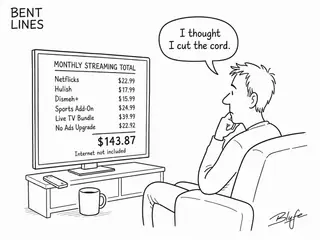
Black-and-white Bent Lines sketch of a customer holding a working phone while a clerk points to a broken old phone receiving the security code.

Bent Lines BL0048

Two-Factor Security

A security code is sent to a broken old phone, protecting the account from its legitimate user.

Bent Lines

Two-Factor Security

Secure from everyone, including the owner.

Black-and-white Bent Lines sketch of a customer holding a working phone while a clerk points to a broken old phone receiving the security code.
Read the visual transcript and evidence receipt

Figure transcript

Main point

The security factor proves possession of a device the legitimate user can no longer use, so the protection mechanism becomes the access failure.

Reading order
  1. A customer and clerk stand across a counter holding phones.
  2. The clerk says, “Code sent to your old phone.”
  3. The customer says, “Very secure.” The clerk answers, “Especially from you.”
Material labels and values

The dialogue reads “Code sent to your old phone.” “Very secure.” “Especially from you.” One phone is visibly broken. The handwritten stacked “BENT / LINES” series mark appears at the upper left. The approved Blyfe signature appears at the lower right.
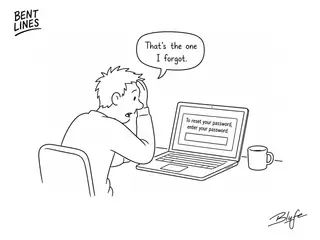
Scope and caveats

This is an editorial scene, not a recommendation to weaken authentication or a claim that two-factor security is generally harmful. Strong recovery controls protect accounts; the point is the failure mode when identity and device possession diverge. The scene is a compressed editorial observation and does not establish prevalence, intent, legality, or harm by itself.

Editorial layer

Claim layer: Argued. The final line separates security from practical ownership by showing a system that blocks the rightful user successfully.

Update and correction status

Status: current. The owner-approved spatially rebalanced master supersedes the previously admitted file. The scene moved within the shared canvas; its dialogue, lettering, marks, linework, and comic meaning did not change. The current source-master SHA-256 is 4f168bf459e03fb77a37f72f45fcfea945b6f24e55543a4791906769976390da; the superseded source-master SHA-256 was b235935aa73d527ac9501cbe669730a1e3c45b1f2290cbc24aab808ef084d10d. The website serves a complete-composition PNG rendition and governed WebP derivatives.

Evidence receipt

Black-and-white Bent Lines sketch of a customer and support worker at a computer discussing files stored safely in the cloud but unavailable for access.

Bent Lines BL0049

Cloud Storage

Support explains that inaccessible files remain safe because safety and access should not be confused.

Bent Lines

Cloud Storage

Nothing can happen to files nobody can reach.

Black-and-white Bent Lines sketch of a customer and support worker at a computer discussing files stored safely in the cloud but unavailable for access.
Read the visual transcript and evidence receipt

Figure transcript

Main point

The service claims success on preservation while treating the user’s inability to retrieve the preserved object as a separate issue.

Reading order
  1. A customer sits across a desk from a support worker.
  2. The worker says, “All your files are safely in the cloud.”
  3. The customer asks, “Can I access them?” The worker replies, “Let’s not confuse safety with access.”
Material labels and values

The dialogue reads “All your files are safely in the cloud.” “Can I access them?” “Let’s not confuse safety with access.” A cloud icon appears on the monitor. The handwritten stacked “BENT / LINES” series mark appears at the upper left. The approved Blyfe signature appears at the lower right.

Scope and caveats

This is an editorial scene, not a report about a named storage provider or a technical claim that cloud storage is inaccessible. Availability and durability are distinct engineering properties, and both can be measured. The scene is a compressed editorial observation and does not establish prevalence, intent, legality, or harm by itself.

Editorial layer

Claim layer: Argued. The joke exposes how a narrow success metric can remain technically intact after the user-facing purpose has failed.

Update and correction status

Status: current. The owner-approved spatially rebalanced master supersedes the previously admitted file. The scene moved within the shared canvas; its dialogue, lettering, marks, linework, and comic meaning did not change. The current source-master SHA-256 is a6ee8b600a7f77e083a6502e60eca74a6da53f33744991fc251a3152fc506d30; the superseded source-master SHA-256 was c3454dc790666b30b8a2edd21008758d1008d6836abd0023a15822646db7c796. The website serves a complete-composition PNG rendition and governed WebP derivatives.

Evidence receipt

Black-and-white Bent Lines sketch of a customer beside a payment kiosk asking an employee why a convenience fee appears.

Bent Lines BL0050

Convenience Fee

A kiosk charges a convenience fee because self-service saves the institution the inconvenience.

Bent Lines

Convenience Fee

The convenience belongs to the other side of the screen.

Black-and-white Bent Lines sketch of a customer beside a payment kiosk asking an employee why a convenience fee appears.
Read the visual transcript and evidence receipt

Figure transcript

Main point

The fee is named for the customer’s benefit, while the explanation identifies the institution as the party spared the work.

Reading order
  1. A customer stands beside a payment kiosk with an employee.
  2. The kiosk displays a line item labeled “CONVENIENCE FEE.”
  3. The customer asks, “What’s the convenience fee for?” The employee answers, “It saves us the inconvenience.”
Material labels and values

The kiosk says “CONVENIENCE FEE.” The dialogue reads “What’s the convenience fee for?” and “It saves us the inconvenience.” The handwritten stacked “BENT / LINES” series mark appears at the upper left. The approved Blyfe signature appears at the lower right.

Scope and caveats

This is an editorial scene, not a claim that every convenience fee is unjustified or that every self-service channel lowers provider cost. Payment processing, platform, and service costs can be real; the issue is who receives the named convenience. The scene is a compressed editorial observation and does not establish prevalence, intent, legality, or harm by itself.

Editorial layer

Claim layer: Argued. The revised punchline moves the claimed benefit to the institution and leaves the customer performing the work while paying the fee.

Update and correction status

Status: current. The owner-approved spatially rebalanced master supersedes the previously admitted file. The scene moved within the shared canvas; its dialogue, lettering, marks, linework, and comic meaning did not change. The current source-master SHA-256 is eed4db5c27bde3ae82726014a8d440fa0c8e7bfd1037b35c4d7a38bf3b34b2f0; the superseded source-master SHA-256 was 583383be6813919cee4c8540365862ae25b8b720d6dadca9282b5960ef31fbce. The website serves a complete-composition PNG rendition and governed WebP derivatives.

Evidence receipt

  • External data: None. This Bent Line is an editorial observation and does not present empirical findings.
  • Approved master: BL0050-Convenience-Fee.png, 1448 × 1086 pixels.
  • Approval record: Publisher approval for BL0039–BL0050.
  • Supersession record: Spatial revision recorded August 29, 2026.
  • Related bent.WTF records: hidden cost, cost migration, sludge.