
 01 · Money Cost Migration The price is not the whole cost The first price can leave out required charges, smaller quantities, work you must do yourself, upkeep, risk, or the cost of leaving. Follow the deal until the obligation is actually finished. For example: A $199 hotel room becomes $238 before tax when a required fee appears later.
Start Here · The introduction
Something is off. Put it on the table.
Think of this page as the front door to bent.WTF. It introduces five ways to look at a bill, a wait, a rule, an offer, or an official number. The Library, visuals, and longer analysis go much farther once you know what you are looking for.
Begin with something you have already felt: a total that grew after checkout, a form that ate an afternoon, or a number that never quite matched the household. We will slow it down, find what moved, and show what the evidence can honestly support.

Time tax
What did the process require before it delivered anything?
Count the forms, calls, waits, retries, and decisions. Keep elapsed time, personal effort, access, and outcome on separate lines.
The working idea
The first visible measure is often useful. It is rarely the whole question. A price can omit time. Access can exist on paper. An average can be accurate while hiding the distribution underneath it.
The discipline
Do not begin with blame. Begin with the object. Separate evidence, inference, and argument. Keep money, time, labor, risk, and access on distinct lines unless a defensible method connects them.
A short introduction
Five ways into bent.WTF.
This five-part introduction gives you the basic idea before the site opens into deeper field records, visuals, and long-form analysis. Each page begins with something ordinary: a price, a wait, a number, an offer, or a process. Start with the one you have already felt.
01 · Money Cost Migration The price is not the whole cost The first price can leave out required charges, smaller quantities, work you must do yourself, upkeep, risk, or the cost of leaving. Follow the deal until the obligation is actually finished. For example: A $199 hotel room becomes $238 before tax when a required fee appears later.  02 · Time Time Tax Waiting is a cost A five-minute form can still consume an afternoon. Count the search, hold, travel, repeat work, and follow-up, while keeping hands-on effort and background waiting separate. For example: The call lasts seven minutes after someone answers; reaching that point takes fifty.
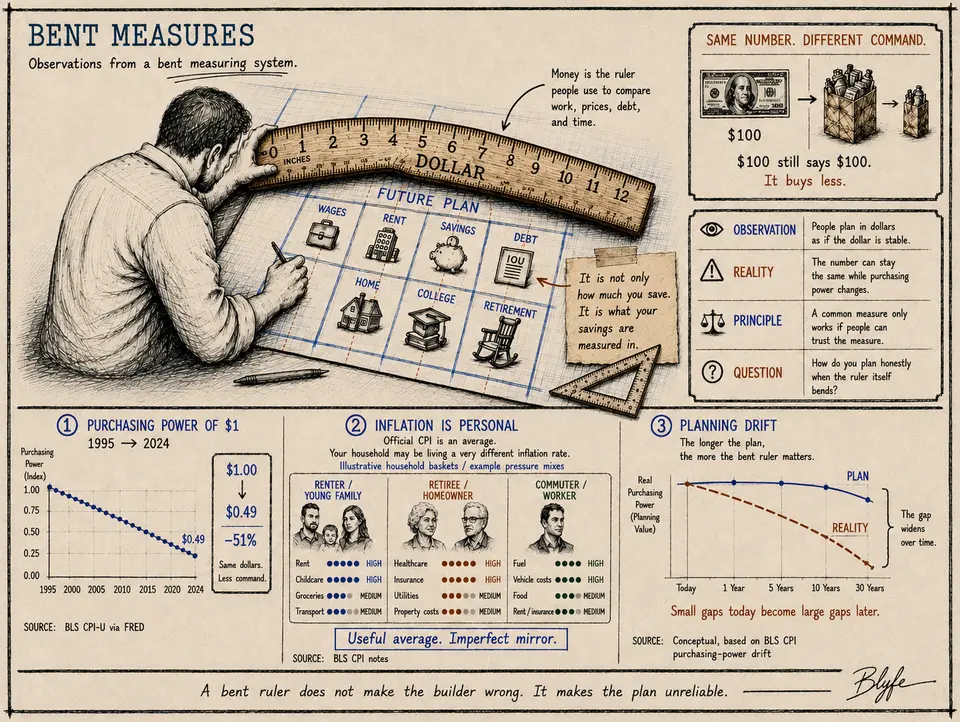 03 · Numbers Measurement Failure The measure is not the reality A statistic answers a defined question. Trouble starts when a headline stretches it across more people, more time, or a larger idea than the method covers. Check who and what was counted. For example: An average can rise even while most households see little change.
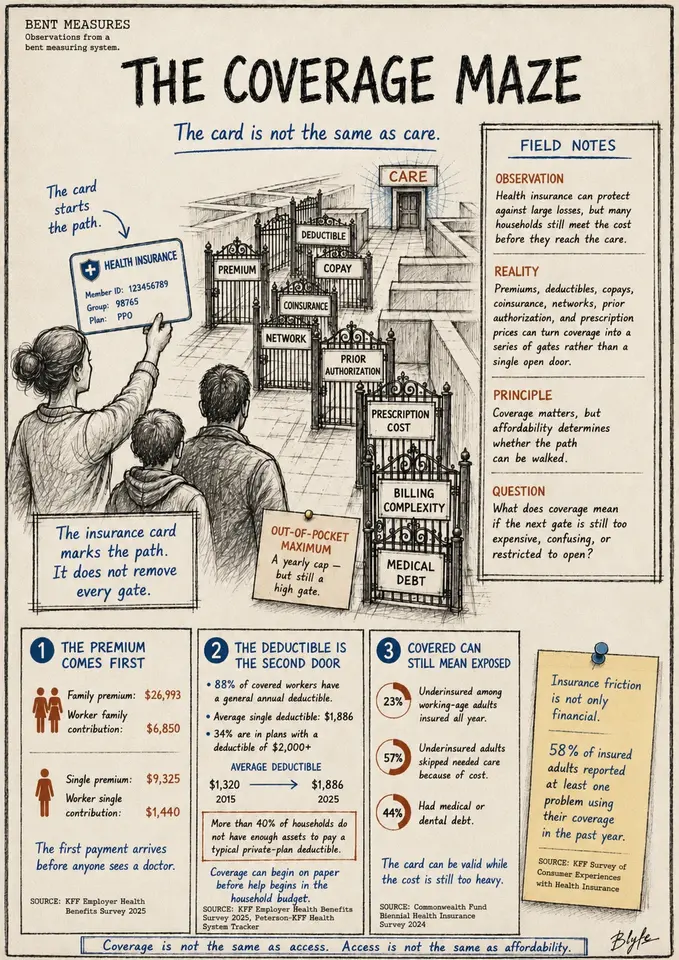 04 · Access Access Distortion An offer is not access A service can be open and still be hard to use. Papers, devices, office hours, travel, language, money, and recovery rules decide whether a person can get through. For example: A clinic takes the insurance plan, but booking still depends on a referral and prior approval. 05 · Institutions Institutional Drift One promise, many processes Rules, vendors, handoffs, and local targets can pile up until every part has an owner and the whole experience does not. Trace the promise, the route, and what later repairs changed. For example: Every department finishes its step while the person between them keeps waiting.
After this orientation, keep going through the Library, visuals, and longer analysis. Each card opens a plain-language explanation, an everyday example, the strongest countercase, the open questions, and links into the larger record.
Choose your own front door
Begin with the part that already bothered you.
You can follow the sequence or simply open the part that sounds familiar. Every path ends with the same habit: say what moved, show the record, and leave the unknowns visible.
Money
The first price looked clean. What moved off it?
Build a comparison that keeps mandatory, expected, conditional, and uncertain costs distinct.
Time
The service still exists. Who does the work now?
Record active work, waiting, repetition, and handoffs without pretending every hour has one dollar value.
Numbers
The number may be accurate. Does it answer the question?
Inspect definitions, scope, denominators, adjustments, revisions, and exclusions before drawing a conclusion.
Six core ideas
A reading path, not a classroom.
Read these in order when you want the full method, or open the one that fits what you noticed. There is no timer and nothing to turn in. Start with the object. Name the mechanism only after the facts are on the table.
Cost Migration
The First Number
A room is listed at $199. The required total appears later.
The first number gets into your head before the full deal does. Once you have compared dates, seats, rooms, or plans around it, a later charge has an advantage: you have already spent time choosing.
The part people feelYou have compared three tabs, chosen the dates, entered the names, and decided which option wins. Then the total changes. Starting over is possible, but it means throwing away work and reopening choices you thought were settled. That is the quiet leverage of the first number.
Ask: What does every buyer have to pay before the transaction can happen?
Run the check
- Write down the first visible number.
- List every mandatory charge required to complete the purchase.
- Keep optional and genuinely conditional costs on separate lines.
- Compare like with like.
What this looks like
- A $42 ticket gains a required service charge after the seats are selected.
- A hotel rate looks lowest in the search results, then adds a required property fee.
- A monthly plan reaches the advertised price only with autopay, paperless billing, and another condition.
Try to disprove yourself
A later charge is not automatically hidden or illegitimate. Taxes, optional upgrades, and costs that depend on a buyer's later choice may belong on different lines.
Transfer it
Use the same test on a ticket, rental listing, delivery order, or telecom plan.
Cost Migration
Where the Cost Went
The sticker price holds while the package shrinks, the service thins, or the buyer accepts more risk.
A cost can move without becoming a fee. The package can shrink. Help can become self-service. A warranty can narrow. The same sticker price can survive while the buyer receives less or carries more risk.
The part people feelNothing on the shelf announces that you are buying less. The box looks familiar and the price has barely moved. You usually notice later—when it runs out sooner, when the old and new packages sit side by side, or when a task you assumed was included suddenly becomes yours.
Ask: Did the cost disappear, or did its form and bearer change?
Run the check
- Name the original obligation.
- Identify what changed: money, quantity, quality, labor, maintenance, or risk.
- Name who carried it before and who carries it now.
- State what the available evidence cannot establish.
What this looks like
- The familiar box keeps its shelf price but contains fewer ounces.
- A staffed service desk becomes an app, and the customer now performs the setup and correction work.
- The premium changes little while the deductible shifts more of a bad outcome onto the household.
Try to disprove yourself
Unbundling can preserve choice, and self-service can save time. The mechanism matters more than the label.
Transfer it
Trace one household task that used to be included in a service and is now performed by the customer.
Time Tax
The Second Receipt
The fee is visible. The search, form, hold, correction, and appeal are not.
The money receipt records what left the bank account. The second receipt records what the process took out of the day: searching, holding, uploading, driving, repeating, correcting, and checking whether anything happened.
The part people feelYou remember the support call as the afternoon it swallowed. The organization may record seven minutes—the part after someone answered. Both descriptions can be accurate. The missing record is everything that happened between deciding to call and knowing the problem was actually fixed.
Ask: What work was required before, during, and after the transaction?
Run the check
- Separate active work from elapsed waiting.
- Record repeated steps and information entered more than once.
- Mark handoffs among the person, institution, software, and third party.
- Stop where the evidence stops.
What this looks like
- A support call contains four minutes of conversation and fifty minutes of waiting.
- An application asks for the same address and document in three different places.
- A cancellation is submitted online but still requires a follow-up call and a confirmation check.
Try to disprove yourself
A long elapsed process is not always a long active burden. Do not count an unattended wait as if it were continuous labor.
Transfer it
Record the next support call or application process as a sequence of actions instead of one rough memory.
Measurement Failure
The Bent Measuring Stick
An average rises while many households report a different experience.
A number can be accurate and still be asked to do a job it was never built to do. Averages hide distributions. Rates depend on denominators. Indexes describe defined baskets and populations, not every household or every lived experience.
The part people feelA headline says the burden fell, but your rent, groceries, or insurance say otherwise. Your experience does not automatically defeat the statistic, and the statistic does not automatically erase your experience. The useful next move is to find out exactly what the number measured.
Ask: What does the measure include, and what do people often assume it includes?
Run the check
- Write the question in ordinary language.
- Find the metric's formal definition.
- Inspect its unit, population, numerator, denominator, and time period.
- List adjustments, exclusions, revisions, and plausible alternative measures.
What this looks like
- An average rises even though the median person sees little change.
- An on-time rate improves because the definition or denominator changed.
- A national price index is treated as a complete account of one household’s cost of living.
Try to disprove yourself
An incomplete measure is not necessarily a bad measure. It may be answering a narrower question correctly.
Transfer it
Take one chart you saw this week and identify the denominator before interpreting its trend.
Access Distortion
Available on Paper
A service is formally open, but the route requires documents, devices, travel, timing, or persistence some people do not have.
A service can exist, a person can qualify, and the practical doorway can still be closed. Documents, devices, office hours, geography, language, disability, and recovery rules decide whether formal access becomes usable access.
The part people feelThe letter says you qualify. The website says the office is accepting people. Then the phone loops, the document upload fails, or the next appointment lands after the deadline. The promise may be real. So is the doorway that never quite opens.
Ask: What must a person possess or do before formal access becomes practical access?
Run the check
- State the formal promise.
- Map every gate between eligibility and use.
- Record money, time, documentation, geography, language, disability, and technology requirements.
- Identify where people leave or are removed from the path.
What this looks like
- A clinic accepts the insurance plan but requires a referral and prior authorization before scheduling.
- An online benefit requires a current phone, a verification code, and identity documents in a specific format.
- An in-person service is available during hours that overlap the applicant’s work shift.
Try to disprove yourself
A gate may protect privacy, safety, scarce capacity, or program integrity. Test whether the burden is proportionate and whether a workable alternative exists.
Transfer it
Map the path from 'eligible' to 'received' for one real service.
Institutional Drift
How Systems Drift
Each added rule has a reason. The combined process becomes unreasonable anyway.
Some bad systems were never designed as a whole. A safety check, vendor portal, legal notice, local target, and exception process arrive one at a time. Each has an owner. The full burden often does not.
The part people feelThe person on the phone may be helpful and completely powerless. Their department followed its rule. The next department followed another one. You can meet competent people at every stop and still end up inside a process that makes no sense as a whole.
Ask: Which incentives, handoffs, metrics, vendors, and accumulated procedures produced the current system?
Run the check
- Describe the system's stated purpose.
- Build a timeline of material additions and ownership changes.
- Identify what each participant is rewarded or punished for.
- Distinguish design, tradeoff, neglect, inertia, and deception.
What this looks like
- Five departments add separate checks after five different incidents.
- A new vendor portal duplicates information already held by the original system.
- Every team meets its local performance target while the person moving between teams waits longer.
Try to disprove yourself
Complexity is not proof of conspiracy or incompetence. Some systems are complex because the underlying work is complex.
Transfer it
Choose one familiar procedure and ask which step no longer has a clear owner.
Five ways to look again
Put the missing lines back.
These reading guides slow the story down long enough to reveal a fee, a wait, a gate, a changed measure, or a promise that got lost between departments.
Price Autopsy
Build the full comparison line.
- First visible price
- Mandatory charges
- Expected use costs
- Financing
- Maintenance
- Conditional risk
- Exit costs
Worked example · Hotel room shown at $199
- First visible price: $199
- Mandatory charge: $39 required resort fee
- Comparison price: $238 before applicable taxes
- Conditional or optional lines remain separate
Where this method stops
- Use actual terms and dates; a sample offer is not a market-wide prevalence estimate.
- Do not add optional, uncertain, and mandatory costs as though they have equal probability.
Transfer: Try the same lines on a ticket, rent listing, telecom plan, vehicle payment, or subscription.
Do not collapse uncertain exposure into a guaranteed total. Keep the lines visible.
Time Tax Receipt
Record the work the process demanded.
- Discovery and search
- Active form or task time
- Waiting
- Repeated work
- Coordination and travel
- Correction or appeal
- Unfinished burden
Worked example · IRS estimate for a 2025 nonbusiness individual filer
- Active pre-filing and filing work: 8-hour national average
- Out-of-pocket preparation cost: $160 national average
- Tax owed or refunded: separate line
- State and post-filing work: outside this receipt
Where this method stops
- An average is not a forecast for one person.
- Keep active work, elapsed waiting, cash cost, and tax liability separate.
Transfer: Use the receipt on an insurance claim, benefits application, cancellation, return, or account-recovery path.
Keep active work and elapsed waiting separate. Do not invent a universal hourly price.
Bent Number
Interrogate the measuring stick.
- Question being asked
- Metric and definition
- Unit
- Population
- Numerator and denominator
- Adjustments and revisions
- Exclusions
- Alternative measure
Worked example · CPI-U, U.S. city average, all items
- Question: average covered consumer-price change
- Population: urban consumers represented by CPI-U
- Owner housing: shelter consumption through rental equivalence
- Household-specific lived cost: outside the index's complete frame
Where this method stops
- A scope boundary is not proof that a statistic is false.
- A specific methodological criticism must name the series, population, period, category, and method.
Transfer: Try the record on wages, school ratings, hospital scores, customer satisfaction, or on-time performance.
A number can be accurate and still be insufficient for the question in front of it.
Access Gate Receipt
Trace the offer all the way to a usable outcome.
- Offer or eligibility
- Required gate
- First decision
- Rework or appeal
- Time and resources
- Outcome or unknown
Worked example · Hypothetical clinic access path
- Offer: accepting new patients under the stated plan
- Gate: network confirmation, referral, and authorization
- Rework: scheduling call after the first request stalls
- Outcome: appointment received, denied, abandoned, or still unknown
Where this method stops
- This field sheet does not determine legal eligibility, medical necessity, or entitlement.
- A gate can serve a legitimate purpose; the receipt records its burden and result before judging it.
Transfer: Use the receipt on a benefit, account, appointment, permit, school application, or insurance path.
Formal availability is the first line. Keep the gates, rework, time, and outcome attached before calling the offer accessible.
Promise-to-Process Test
Put the stated purpose beside the process that delivered it.
- Stated promise
- First delivery
- Burden moved
- Repair
- Later record
- Persistence, mismatch, or unknown
Worked example · Hypothetical one-form service
- Promise: one form and one clear decision path
- First delivery: separate owners, notices, and correction channels
- Repair: one handoff was consolidated after the first release
- Later record: improved, unchanged, newly broken, or not yet measured
Where this method stops
- A mismatch does not establish motive, deception, or permanent failure.
- The later record must be comparable enough to show whether the original burden changed.
Transfer: Use the test on a public program, customer-service promise, school process, workplace system, or regulated service.
Keep the later record in the main case. A repair can narrow the finding, and complexity alone does not prove drift.
Burden Receipt
Write down what the official transaction leaves off its receipt.
- Visible price, benefit, or decision
- Mandatory money
- Active work
- Constrained waiting
- Travel, equipment, and coordination
- Correction, appeal, or exit
- Usable outcome
- Unknown or unmeasured burden
Worked example · A covered medical service requiring prior authorization
- Formal offer: service appears in the plan's covered category
- Gate: clinical information and insurer decision
- Clock: active clinician work kept separate from elapsed review time
- Outcome: approved, denied, appealed, alternative received, or still unknown
Where this method stops
- The receipt reveals missing lines; it does not prove that every burden is avoidable or improperly designed.
- A blank outcome must remain blank until an outcome source or direct record fills it.
Transfer: Use it for housing, care, work, school, utilities, credit, benefits, courts, immigration, or disaster recovery.
Do not convert unlike burdens into one score. Keep money, active work, elapsed time, access, and outcome in their real units.
Bent Burden Atlas
Compare where a burden changes without pretending every place is measured the same way.
- Question and life domain
- Geography and governing institution
- Population and denominator
- Measure and observation period
- Local price, time, or access condition
- Comparison place
- Method difference
- Repair, counterexample, or missing record
Worked example · County childcare-price comparison
- Place: named county and state survey year
- Measure: provider type and child age preserved
- Comparison: another county using a sufficiently comparable field
- Unknown: open slots, schedule fit, quality, and actual household payment
Where this method stops
- The first edition is a documented comparison method, not a live comprehensive map of every burden.
- Geographic difference does not establish which policy, market, or demographic condition caused it.
Transfer: Use the atlas method on housing need, care prices, energy burden, transport cost, court practices, or administrative processing.
A map colors places; it does not make unlike definitions comparable. Preserve the source, year, unit, and denominator for every geography.
State of the Bent
Build a dated baseline that keeps the benefit, burden, repair, and missing evidence together.
- Domain and bounded question
- Best current finding
- Population, place, and period
- Burden bearer
- Legitimate purpose or benefit
- Repair evidence
- Counterevidence
- Open proof and next review date
Worked example · 2026 domain baseline
- Finding: one source-backed burden with its denominator
- Countercase: one benefit, legitimate control, or improving record
- Repair: rule, capacity, redesign, or handoff change and its measured result
- Open proof: the outcome or comparison still needed before a stronger conclusion
Where this method stops
- A baseline cannot certify truth beyond its reviewed sources or forecast conditions after its observation window.
- Model review does not replace accountable source judgment, human read-aloud, accessibility review, or publisher approval.
Transfer: Use one bounded record per domain, then update only when the source, definition, repair, or outcome materially changes.
A state-of-the-system report is a dated control record, not an annual outrage list. Revise or narrow the conclusion when later evidence changes it.
Spot the bend
Now try it without the label.
Each example is hypothetical. Notice your first reaction, then open the note to see which boundary matters.
The late total
A ticket is advertised at $42. A required service charge appears only after seats are selected.
What should be compared?
Look again
Compare the mandatory total available to every buyer at the same stage. Keep optional seat upgrades and genuinely conditional charges separate. This is primarily Cost Migration.
The familiar box
The shelf price is unchanged. The package contains less product and the front design is nearly identical.
What moved?
Look again
The unit changed. Compare price per unit, then investigate whether the relevant measure captures the size change. This can involve both Cost Migration and Measurement Failure.
The exit path
Joining took two minutes. Canceling requires a phone call, a hold, a retention script, and a confirmation check the next day.
What belongs on the second receipt?
Look again
Record active task time, waiting, repeated contact, and confirmation work separately. The asymmetry suggests a Time Tax, but intent still requires evidence.
The average household
A report says the average burden fell. The underlying distribution and median are not shown.
What can the average establish?
Look again
It can describe the stated aggregate under its definition. It cannot by itself show how the change was distributed or what a typical household experienced.
Online only
A benefit is available, but applications require a current device, reliable internet, identity documents, and a verification code sent to a stable phone number.
Is the benefit accessible?
Look again
It is formally available. Practical access depends on several gates. Map them before deciding whether the process works for the intended population.
One reasonable rule at a time
Five departments added separate checks after different incidents. No one owns the full customer path.
What should be investigated first?
Look again
Build the rule and ownership timeline. Test incentives and handoffs before assigning motive. This is a candidate Institutional Drift mechanism, not proof of one.
How to read the record
Read the claim before the conclusion.
A bent.WTF record separates three layers:
- Evidence
- What a source directly reports, measures, requires, or documents.
- Inference
- What follows across sources, with the reasoning and uncertainty left visible.
- Argument
- The editorial judgment: why the finding matters and how the mechanism is best understood.
Check jurisdiction, time period, definition, source date, caveat, and counterevidence. If the record stops, the claim stops with it.
Keep the record underneath.
Use the Library for durable concepts, Evidence Cards for bounded claims, and visuals when the mechanism is easier to inspect than describe.
Continue through the record
Keep the source record beside the claim.
The Library keeps definitions, exhibits, caveats, and related work close enough to check.
Start with an active file. Open the exhibits when a claim does real work.
Open the Library