
Start Here · Money · Cost Migration
The price is not the whole cost
A guided inspection of mandatory charges, changed units, customer labor, financing, upkeep, risk, and exit.
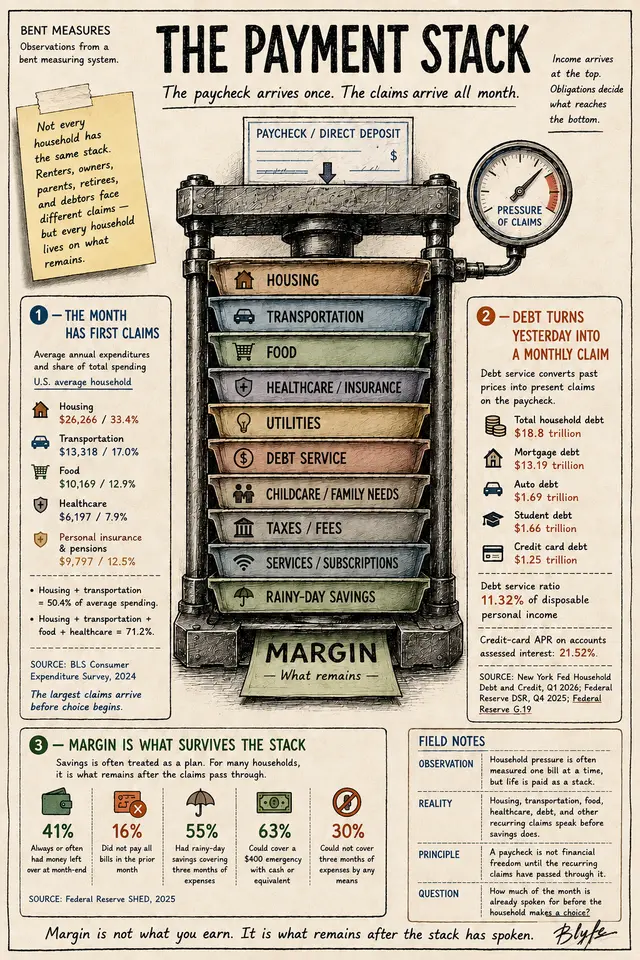
BM0010 · The Payment Stack Mnemonic layer; claims and caveats remain in the record. Inspect the full visual transcript
First, in plain language
Start with the price you were asked to trust.
The first number shapes the choice. A $199 room competes against a $215 room as if those are the full prices. When a required $39 charge appears after the dates are chosen and the names are entered, the original comparison no longer works.
Money can move without adding a new fee. A package shrinks, service becomes self-service, a repair becomes the buyer’s problem, or an easy exit becomes an expensive one. Follow the deal until the obligation is finished, then keep the different kinds of cost on their own lines.
-
Write down the first number
Save the price, page, date, unit, and conditions that were visible while the choice was still being made.
-
Follow what every buyer must carry
Look for required fees, changed quantity, customer work, upkeep, financing, risk, and exit. Label each one instead of forcing them into a single dramatic total.
-
Compare the same deal
Keep mandatory charges separate from optional upgrades and costs that may never occur. Leave a line marked unknown when the record does not settle it.
Object on the table
A hotel room shown at $199, with a required $39 fee added later.
Do not solve it from the headline. Preserve the first description, then work the route.
Bounded finding
What this path can establish
A useful comparison restores the obligations required for the transaction and the burdens predictably carried afterward. Mandatory, expected, optional, conditional, and unknown lines remain separate.
Try to disprove it
The strongest honest countercase
Unbundling can preserve choice. A later charge can also be legitimate and clearly disclosed. The question is whether the first comparison still carried enough information for the decision being made.
A way to look again
Price Autopsy
Do not turn unlike burdens into one theatrical total. Preserve the lines and label their certainty.
Pause here: Which of these lines would have changed your last decision if it had appeared sooner?
- 01First visible price
- 02Mandatory charges
- 03Changed quantity or quality
- 04Customer work
- 05Financing and upkeep
- 06Conditional risk
- 07Exit cost or unknown
Continue through the introduction
Notice it. Trace it. Use the method.
Pause here
What can you see differently now?
- Can you state the first visible price and the mandatory comparison price without mixing them?
- Can you name who carried each obligation before and who carries it now?
- Can you keep financing, maintenance, risk, and exit exposure from becoming one theatrical total?
- Can you describe a countercase in which unbundling improves choice?