
Start Here · Access · Access Distortion
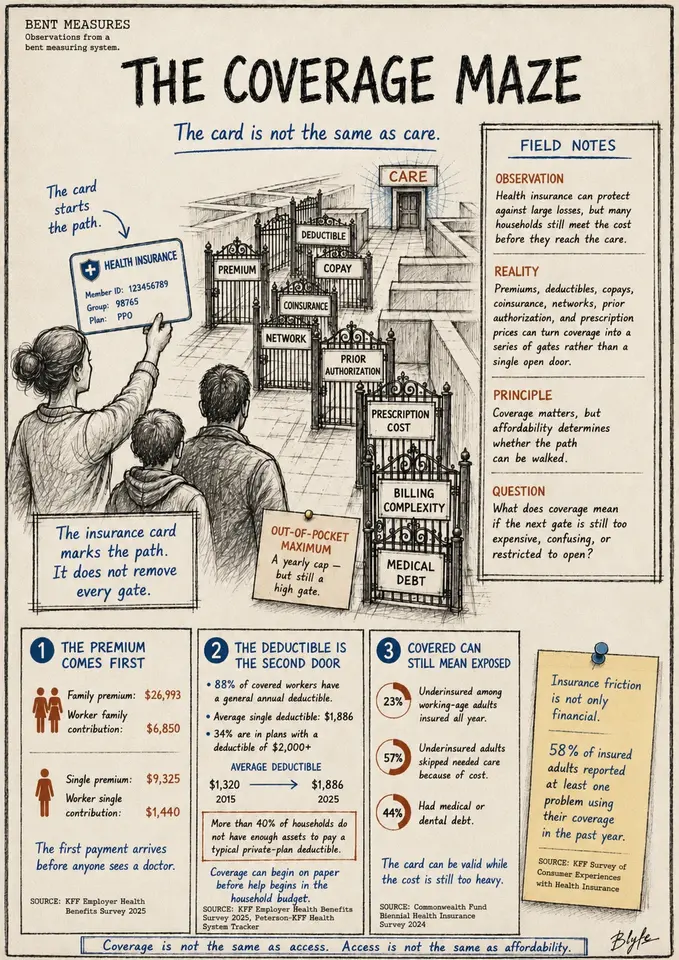
An offer is not access
A guided inspection of the gates between a published offer, formal eligibility, a first decision, rework, and a usable outcome.
BM0009 · The Coverage Maze Mnemonic layer; claims and caveats remain in the record. Inspect the full visual transcript
First, in plain language
Follow the promise all the way to a usable result.
“Available” usually describes the offer. A person still needs the right papers, time, travel, device, language help, money, or phone number. One failed upload or missed office hour can close a doorway that looked open on paper.
A real access check starts with who qualifies and ends with who receives the service. Every gate in between matters. Some gates protect safety, privacy, limited space, or the fairness of a program. Ask whether the gate does its job, whether the burden makes sense, and what happens when the usual route fails.
-
Copy the actual promise
Start with the official rule about who qualifies, what is covered, or where the service is offered. Keep its exact limits visible.
-
Draw the route
Mark every document, device, payment, appointment, approval, trip, waiting list, and retry between qualifying and receiving the service.
-
Record the result
Received, delayed, denied, abandoned, or still unknown are different outcomes. The offer alone cannot tell you which one occurred.
Object on the table
A service described as available online, with identity, device, document, timing, and recovery requirements left outside the word available.
Do not solve it from the headline. Preserve the first description, then work the route.
Bounded finding
What this path can establish
Formal availability begins the access question. Practical access depends on the gates between eligibility and receipt, the burden of rework, and whether a usable alternative exists when the ordinary path fails.
Try to disprove it
The strongest honest countercase
A gate may protect privacy, safety, scarce capacity, or program integrity. The inspection asks whether the gate works, whether its burden is proportionate, and whether the fallback is real.
A way to look again
Access Gate Receipt
Do not call the offer accessible until the path from eligible to received can be inspected.
Pause here: Which of these lines would have changed your last decision if it had appeared sooner?
- 01Offer or eligibility
- 02Required gate
- 03First decision
- 04Rework or appeal
- 05Time and resources
- 06Outcome or unknown
Continue through the introduction
Notice it. Trace it. Use the method.
Pause here
What can you see differently now?
- Can you state the formal offer without widening it?
- Can you map the resources and actions required before receipt?
- Can you distinguish a necessary gate from an unnecessary or disproportionate one?
- Can you leave an outcome unknown when the record does not publish it?