
Start Here · Institutions · Institutional Drift
One promise, many processes
A guided inspection of the distance between a stated purpose and the accumulated rules, owners, vendors, repairs, and handoffs that deliver it.
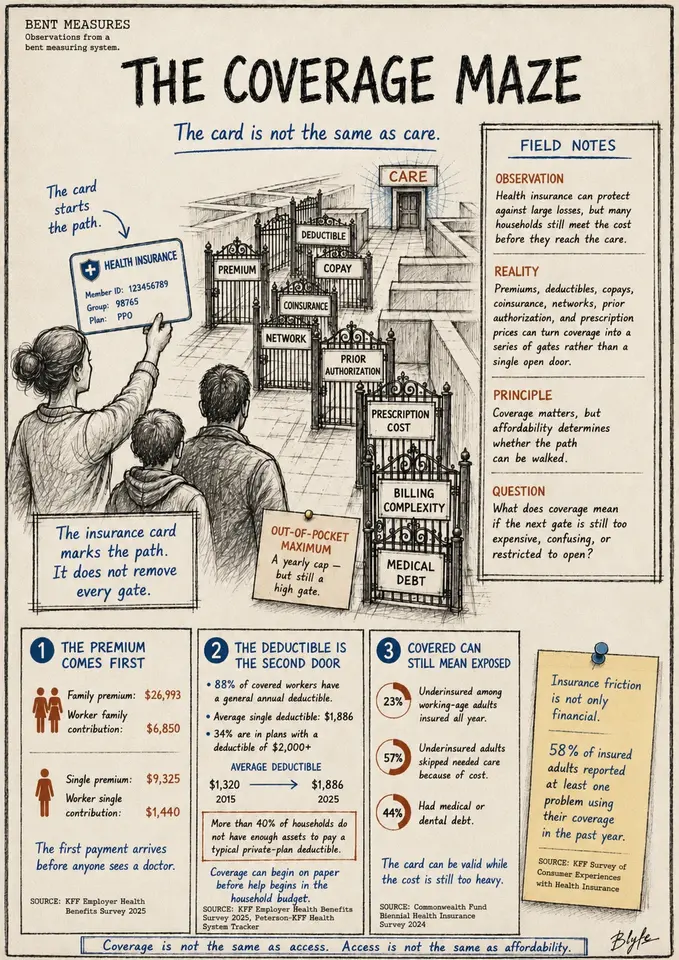
BM0009 · The Coverage Maze Mnemonic layer; claims and caveats remain in the record. Inspect the full visual transcript
First, in plain language
Look at the whole route from promise to result.
Many frustrating systems were assembled one reasonable rule at a time. A security check followed a failure. A vendor added a portal. Legal required another notice. Each team can finish its own task while the person moving between them keeps carrying the delay.
This lens asks who owns the end-to-end result. Build a timeline, follow the handoffs, and check what later repairs changed. Motive comes last. A bad route can grow from incentives, risk controls, old technology, local targets, or neglect without a single person designing the final mess.
-
Recover the original promise
Use the institution’s own words. Then identify the first process that tried to deliver that promise.
-
Follow additions and handoffs
Build the shortest timeline the record supports. Mark new rules, vendors, owners, measures, exceptions, and places where the user becomes the messenger.
-
Check the later record
A repair belongs in the main story. Find out whether it changed the full route, moved the burden somewhere else, or has not been measured yet.
Object on the table
A process advertised as one application, delivered through several owners, notices, portals, clocks, and correction paths.
Do not solve it from the headline. Preserve the first description, then work the route.
Bounded finding
What this path can establish
Institutional drift is a candidate explanation when the stated purpose, delivered process, burden bearer, later repair, and remaining mismatch can be traced over time. Complexity alone does not establish drift.
Try to disprove it
The strongest honest countercase
Some systems are complex because the underlying work is complex. A later repair, improving outcome, or well-performing comparison can narrow or defeat a persistence claim.
A way to look again
Promise-to-Process Test
Keep the later record in the main case. A repair is evidence, not a footnote.
Pause here: Which of these lines would have changed your last decision if it had appeared sooner?
- 01Stated promise
- 02First delivery
- 03Burden moved
- 04Repair
- 05Later record
- 06Persistence, mismatch, or unknown
Continue through the introduction
Notice it. Trace it. Use the method.
Pause here
What can you see differently now?
- Can you quote the promise without replacing it with a broader ideal?
- Can you name the first delivery and the burden it moved?
- Can you keep tradeoff, neglect, inertia, incompetence, and deception distinct?
- Can you include a later repair without using it to erase the first failure?