
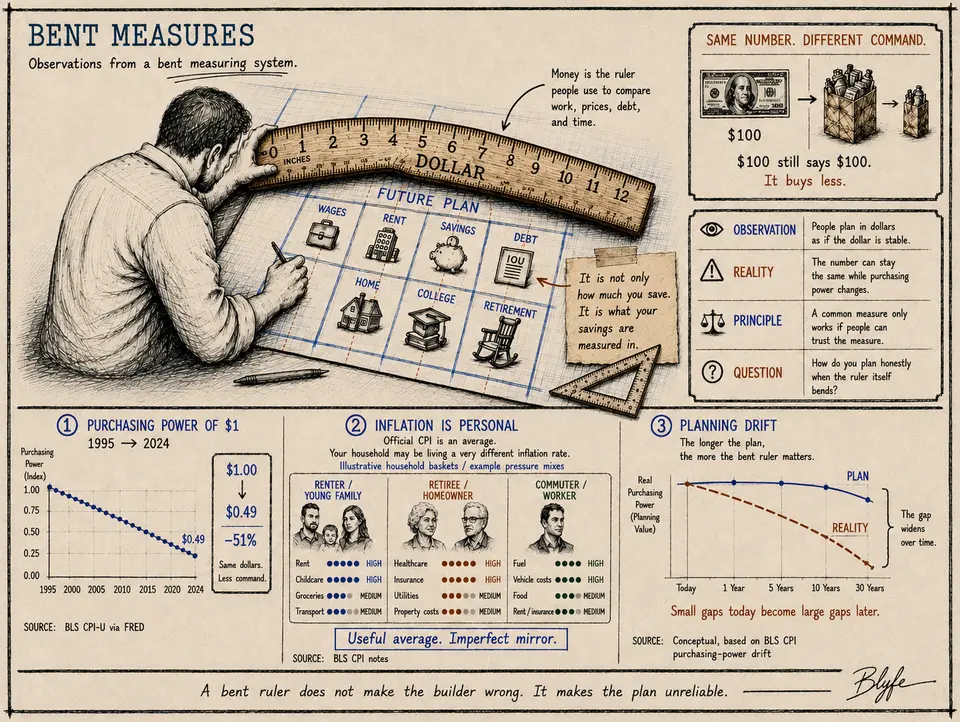
Start Here · Numbers · Measurement Failure
The measure is not the reality
A guided inspection of definitions, scope, populations, denominators, adjustments, exclusions, revisions, and the claims a measure cannot carry.
BM0002 · The Bent Measuring Stick Mnemonic layer; claims and caveats remain in the record. Inspect the full visual transcript
First, in plain language
Ask what the number was built to measure.
A number does not arrive with one universal meaning. An average describes a group under a set of rules. A rate depends on who is counted and on its denominator—the total or group used for the comparison. An index follows a defined set of items or changes; it does not become a complete biography of every household.
Most trouble starts in the sentence around the number. A careful measure gets stretched into a larger claim about typical people, fairness, success, or lived cost. Read the definition, find the population and denominator, and then decide how far the conclusion can travel.
-
Say the question in ordinary words
Write what you think the chart answers before reading the technical definition. The gap between those two statements is where misuse often begins.
-
Open the label
Find the people or things counted, the unit, the period, the denominator, and any exclusions or revisions. These details set the meaning of the result.
-
Draw the boundary
State what the measure supports and what it cannot establish by itself. A narrow boundary can make a number useful; it does not make the number false.
Object on the table
A consumer-price index used as though it were a complete account of one household’s cost of living.
Do not solve it from the headline. Preserve the first description, then work the route.
Bounded finding
What this path can establish
A measure should be read inside the question, population, unit, period, denominator, and method that produced it. A scope boundary narrows the lawful claim; it does not by itself make the measure false.
Try to disprove it
The strongest honest countercase
An incomplete measure may be answering a narrower question correctly. A cleaner alternative can also introduce a different omission, lag, or tradeoff.
A way to look again
Bent Number Record
Respect the measure. Refuse the extra claim it was not built to carry.
Pause here: Which of these lines would have changed your last decision if it had appeared sooner?
- 01Question in ordinary language
- 02Formal metric definition
- 03Unit and population
- 04Numerator and denominator
- 05Period and geography
- 06Adjustments and revisions
- 07Exclusions and alternative measure
Continue through the introduction
Notice it. Trace it. Use the method.
Go deeper · Bent Number Workshop
Nine inspections. One number at a time.
Nine guided inspections for learning what a number measures, where its method stops, and what evidence belongs beside it.
Boundary: CPI-U is the worked methodological case. These modules do not calculate a household inflation rate or treat statistical adjustment as evidence of manipulation.
- N01 · Measurement primer The Index Has a Job
What exact question was this measure built to answer?
- N02 · Measurement primer The Average Household Does Not Exist
Whose spending pattern enters the average, and whose does not?
- N03 · Measurement primer Shelter Is Not the House
Is the question about consuming shelter or acquiring a housing asset?
- N04 · Measurement primer Substitution Without the Steak Story
At what level does the formula allow purchasing patterns to shift?
- N05 · Measurement primer Quality Is Not One Lever
What happened when the sampled product changed?
- N06 · Measurement primer The Revised Past
Can this published value change after its first release?
- S01 · Source School Read the Footnote
Which sentence in the method changes how the headline should be read?
- S02 · Source School Find the Denominator
What exactly is the reported result divided by, weighted against, or indexed to?
- S03 · Source School Build the Countercase
What is the strongest honest reason the measure may be right for its job?
Six transfer tests
Wages, school ratings, hospital scores, on-time performance, customer satisfaction, and revised data. None arrives with the lens already named.
Pause here
What can you see differently now?
- Can you name the population, unit, period, numerator, and denominator?
- Can you distinguish a methodological choice from a methodological error?
- Can you find the adjustment, exclusion, or revision that matters for the claim?
- Can you offer a better measure without pretending it answers every adjacent question?